Restored and updated October 29, 2026.
Being partly to blame for a pedestrian accident in Texas does not automatically prevent recovery. Under the state’s proportionate-responsibility law, a claimant who is 50% or less responsible may recover damages reduced by that percentage. Responsibility greater than 50% bars recovery in a case governed by that rule.
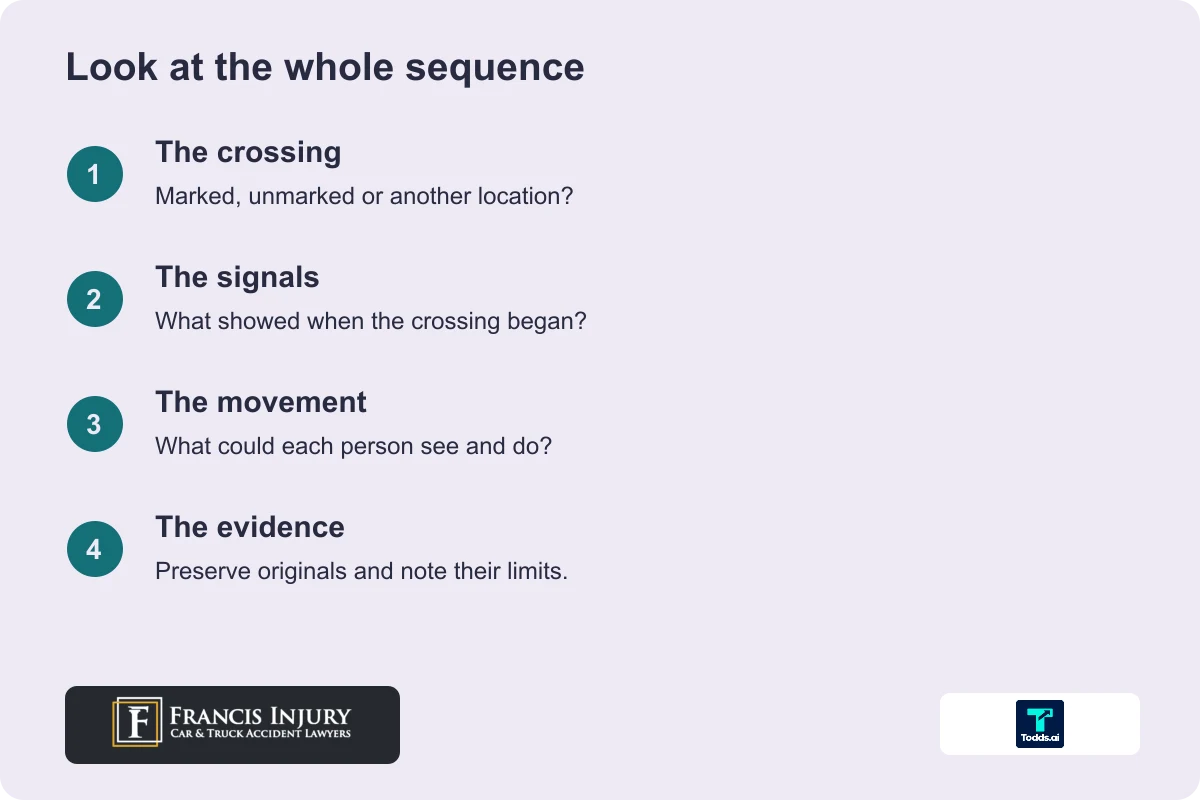
The disputed percentage is not determined just by whether you were outside a painted crosswalk. The crossing location, signals, timing, visibility, driver conduct and evidence all matter. An insurer’s initial assessment is a position to examine, not a substitute for a complete investigation.
What the Texas 50% boundary means
Texas Civil Practice and Remedies Code §§33.001 and 33.012 establish the bar and percentage reduction. Exactly 50% and more than 50% produce different outcomes.
| Proved damages before this reduction | Claimant’s responsibility | Amount after this reduction |
|---|---|---|
| $100,000 | 20% | $80,000 |
| $100,000 | 50% | $50,000 |
| $100,000 | 51% | $0 under the greater-than-50% bar |
These numbers explain the rule, not what any pedestrian injury is worth or what an insurer will pay. Other legal requirements, coverage, settlement credits and deductions can affect a case. Our comparative-negligence guide gives broader context for shared responsibility.
A crosswalk is important, but it is not the only fact
Texas Transportation Code Chapter 552 contains several different crossing rules. Applying the right one starts with identifying the actual location and control signals.
- A pedestrian control signal: a person facing “Walk” may proceed, and vehicles must stop and yield. A person may not start crossing on “Don’t Walk” or “Wait”; someone already partly across after starting on “Walk” proceeds to a sidewalk or safety island.
- No operating traffic signal: §552.003 requires a driver to stop and yield in the specified crosswalk circumstances, including when the pedestrian is on the vehicle’s half of the roadway or approaching closely enough from the other half to be in danger.
- Sudden entry: the pedestrian may not suddenly enter the path of a vehicle so close that the driver cannot stop and yield.
- Outside a marked or intersection crosswalk: pedestrians generally must yield to vehicles. Between adjacent signal-controlled intersections, crossing is permitted only in a marked crosswalk.
An unmarked crosswalk at an intersection can matter, so “there were no painted lines” does not finish the analysis. The statute also permits certain local ordinances. A claim review should identify the exact crossing rather than rely on a general label such as jaywalking.
For help evaluating a North Texas collision, a Fort Worth pedestrian accident lawyer can investigate the conduct and evidence on both sides.
Drivers still have a duty of care
Section 552.008 requires drivers to use due care to avoid hitting a pedestrian, sound the horn when necessary and take proper precautions when observing a child or an obviously confused or incapacitated person. A pedestrian’s possible error does not erase those duties.
That does not mean a driver could have prevented every collision. An investigation should examine speed, attention, sight lines, lighting, stopping opportunity and the sequence of movement. It should also examine facts that may be unfavorable to the pedestrian instead of assuming they do not matter.
Illustrative scenario: a pedestrian crosses midblock and a turning driver hits them. A witness says the driver looked at a phone. That account may prompt investigation, but it does not establish a fault percentage. Investigators still need the crossing layout, timing, opportunity to see and respond, and reliable evidence of the alleged distraction.
Preserve evidence without putting yourself at risk
Get emergency help and medical attention as needed. Do not stay in traffic or return to a dangerous crossing to recreate the incident. Someone else may be able to identify a camera or witness while you receive care.
- Record the exact crossing point, direction of travel, approximate time and weather.
- Identify nearby businesses, residences or vehicles that may have video; footage is not guaranteed to exist or be retained.
- Keep original photographs showing signals, markings, obstructions and the wider scene.
- Save witness contact information and note what each person actually observed.
- Retain medical records and the insurer’s explanation of its fault assessment.
Tell counsel promptly about potential video so lawful preservation requests can be considered. The injury evidence checklist helps organize these materials. Our Texas crash-report guide addresses obtaining another important record.
Match each allegation to a missing fact
Instead of arguing only about the percentage, identify the question the evidence must answer. The following examples organize an investigation; they do not predetermine who was at fault.
| Allegation | What to check | Potential evidence |
|---|---|---|
| “You were outside the crosswalk.” | Was there an unmarked intersection crosswalk, and what rule controlled this spot? | Location photos, intersection layout and applicable signs |
| “You stepped out without warning.” | What were the movements and available time to see and react? | Original video, witness accounts and reconstruction where needed |
| “The signal was against you.” | What did it display when crossing began, and did it change while you were crossing? | Witness observations, video and any available signal records |
A timestamp can be wrong, a witness may have seen only the impact, and a photograph taken later may show changed conditions. Record those limitations with the evidence. “Not available” is different from proof that something did not happen.
How to respond to a disputed fault assessment
Ask what evidence supports the percentage and which actions allegedly contributed to the collision. Record facts honestly, distinguish estimates from certainty and correct misunderstandings through appropriate channels. Do not guess about speed, timing or a signal you did not see.
Get advice before giving a recorded statement to the opposing insurer or signing a release. Your own policy may create separate cooperation obligations, so avoid treating every insurer’s request as identical. A review of settlement options can help frame the next discussion when liability remains disputed.
Check for earlier requirements if a public entity is involved
Many Texas injury claims have a two-year limitations starting point under §16.003, with exceptions. A public vehicle or alleged roadway condition needs separate analysis of immunity and notice.
Section 101.101 generally addresses notice within six months, while qualifying city charter or ordinance requirements can be shorter. Actual-notice rules are fact-specific. Do not assume that a crash report satisfies every requirement, or that a road defect automatically creates a claim against a city.
Questions about pedestrian shared fault
Can I recover if I was exactly 50% responsible?
The Chapter 33 bar applies when responsibility is greater than 50%. At exactly 50%, a covered claim is reduced by that percentage, subject to proving the case and other applicable requirements.
Does crossing outside painted lines make me automatically at fault?
No. Determine whether there was an unmarked intersection crosswalk, what signals controlled the location and which duties applied. Crossing location is evidence to analyze, not an automatic percentage.
Does the police report decide the civil claim?
A report may contain important evidence and assessments, but disputed civil responsibility requires consideration of the full record. An adjuster’s view and a court’s determination are also different things.
Can I still ask a lawyer about the case if I made a mistake?
Yes. Describe your actions accurately. A useful evaluation considers your conduct, the driver’s conduct and the available evidence rather than promising that blame can be removed.
General Texas-law information, not advice for an individual claim. The examples explain legal concepts and do not predict a case result.
 Content prepared with todds.ai

