
Originally published January 17, 2023 (January 18 UTC). Restored and updated October 18, 2026.
Negligence vs intentional wrongdoing in Texas comes down to the legal duty, the conduct and the intent required for the particular claim. Negligence concerns a failure to use reasonable care that causes harm. An intentional tort requires a particular intentional act or consequence; it does not always require a plan to cause the exact injury that followed.
That distinction matters after an injury because it changes what evidence your lawyer needs, which defenses may apply and how insurance coverage is evaluated. Start with what happened and what you can prove. You do not need to decide the legal label before seeking help.
What changes between negligence and an intentional tort?
A negligence claim generally requires a duty, a breach of that duty, an injury proximately caused by the breach and damages. Someone can intentionally perform an everyday action—turning a steering wheel, for example—without intending a harmful or offensive contact. Deliberate movement alone does not answer which claim fits.
| Claim or standard | Central question | Useful evidence |
|---|---|---|
| Ordinary negligence | Did a failure to use reasonable care cause the injury? | Video, scene conditions, instructions, witness observations and injury records |
| Gross negligence | Was there an extreme risk and actual awareness of it, followed by conscious indifference? | Specific warnings, prior knowledge and the conduct after that warning |
| Intentional tort | Did the conduct satisfy the intent and other elements of that particular tort? | The act itself, contemporaneous words, messages, context and available defenses |
The Texas Supreme Court explained an important limit in City of Watauga v. Gordon: a battery does not necessarily require an intent to injure. Intentional offensive contact can result in an injury the actor did not intend. That is a rule about battery, not a single definition covering every intentional tort.
For a crash, connect the conduct question to the larger injury evidence checklist. Photos of damage may show what happened, but they rarely establish a person’s state of mind by themselves.
The same injury can raise different questions
Illustrative example, not a Francis Injury case: a person suffers a broken wrist in a parking area. In one version, a driver backs up without checking and strikes the person. In another, someone deliberately shoves the person during an argument. The injury is similar; the conduct and proof are different.
In the backing collision, investigators would examine visibility, movement, lookout and causation. In the shove, they would investigate the contact, surrounding words and possible defenses such as consent or self-defense. Neither a serious injury nor an angry witness automatically proves the elements of an intentional tort.
If more than one person’s conduct contributed to a collision, see how Texas comparative negligence can affect an injury claim. The application to a particular intentional-tort case needs its own legal analysis.
Gross negligence is more than ordinary carelessness
Texas Civil Practice and Remedies Code §41.001(11) requires both an objectively extreme degree of risk and the actor’s actual awareness of that risk, followed by conscious indifference. A bad outcome alone does not establish those two parts.
Gross negligence can matter to a request for exemplary, or punitive, damages. Section 41.003 requires clear and convincing evidence for that request; ordinary negligence is not enough. Exemplary damages are not automatic, and additional requirements and limits may apply. The purpose and proof differ from compensation for medical expenses or lost income.
Preserve observations before arguing about labels
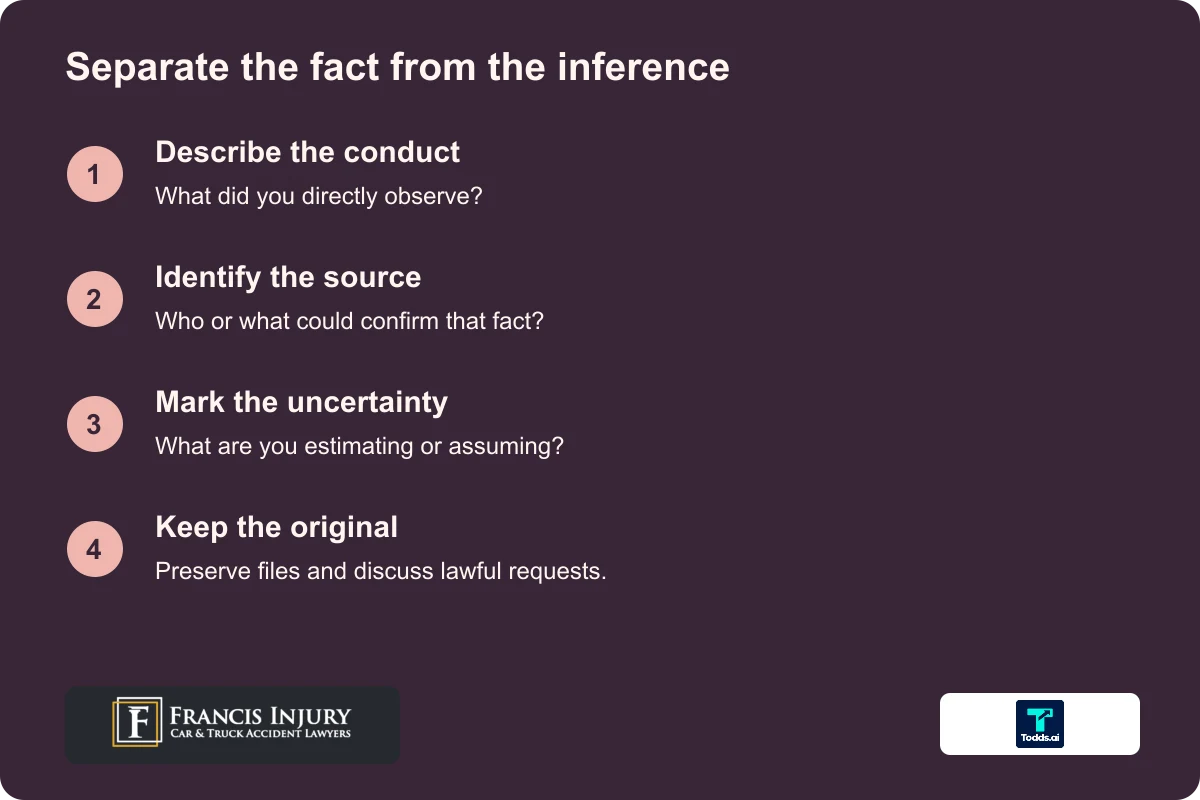
- Write down what you directly saw or heard. Separate it from what someone later told you.
- Keep original photos, videos and messages. Do not edit the only copy.
- Record witness names and ways to contact them; do not coach an account.
- Identify nearby cameras and tell your lawyer promptly. Do not trespass or try to access a private system.
- Keep medical records and a factual account of how the injury affects daily activities.
Our guide to Texas crash reports explains another potential record after a vehicle collision. A report is one source to assess alongside other evidence, not a substitute for examining every disputed fact.
Use a fact-versus-inference worksheet
Before a consultation, make three columns: what you observed, the source that could confirm it and what remains unknown. That helps a lawyer test the legal theory without turning an assumption into an accusation.
| Observed fact | Possible source | Do not assume |
|---|---|---|
| “The vehicle moved backward before contact.” | Original video and a witness who saw the movement | That the driver intended to hit someone |
| “I heard a warning before the person continued.” | Who heard it, the exact words remembered and timing | That one warning establishes gross negligence |
| “My wrist hurt after I fell.” | Clinical history and examination | That the symptom alone proves how the fall happened |
If an entry is based on a later conversation, name that source instead of writing it as a firsthand memory. Preserve information that may cut against your initial explanation, too. Honest uncertainty gives investigators a question to resolve.
Does calling conduct intentional change insurance?
It can raise coverage questions, but the answer depends on the policy, exclusions, allegations and facts. Do not assume that an intentional act makes every potential defendant uninsured. Do not change a truthful account to fit a policy, either. A lawyer can investigate whether another party’s independently negligent conduct contributed to the injury and whether any applicable coverage exists.
For vehicle claims, who pays after a rear-end collision illustrates why responsibility and the source of payment are separate questions. A claim can also involve disputed causation, policy limits or more than one insurer.
Questions about negligence and intentional wrongdoing
Does a criminal case have to finish first?
A civil injury claim and a criminal prosecution serve different purposes. Do not assume that a prosecutor’s decision or a pending investigation extends a civil filing deadline. Ask counsel to evaluate the civil claim and its timing independently.
Can an intentional tort cause an accidental injury?
Yes. For example, the intent relevant to a battery can concern offensive contact even when the resulting injury was unintended. The exact tort, facts and defenses matter; “I did not mean that injury” does not resolve every case.
Is every serious traffic violation gross negligence?
No. The statutory extreme-risk and actual-awareness requirements still need evidence. The violation, conditions, warnings and conduct must be investigated rather than treated as an automatic punitive-damages trigger.
How long do I have to act?
Many Texas personal-injury claims start with a two-year limitations rule, but the claim type and exceptions matter. Chapter 16 contains different provisions, including special rules for certain intentional misconduct. Do not assume one deadline covers every claim or wait for insurance discussions to conclude.
General information about Texas injury claims, not advice for an individual case. Liability, coverage and recovery depend on the facts and applicable law.
 Content prepared with todds.ai

