
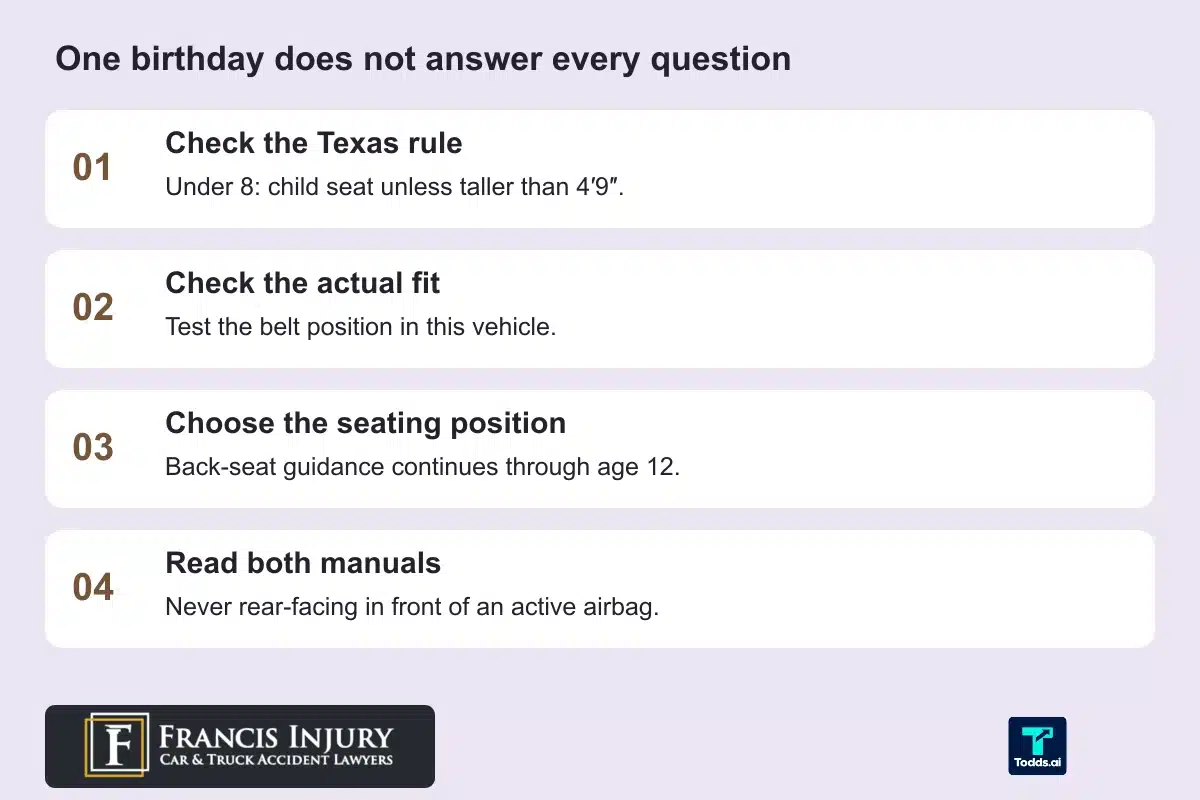
When can a child sit in the front seat of a car? In Texas, there is no single statutory front-seat birthday. The state’s child-restraint rule and the safety recommendation are different: Texas generally requires a child safety seat for children under 8 unless taller than 4 feet 9 inches; safety guidance says children should ride in the back seat through age 12.
Turning 8 does not make the front passenger seat the safer choice. Start with the child’s size, the seat and vehicle instructions, and whether the restraint fits correctly. Never put a rear-facing child seat in front of an active passenger airbag.
The Texas Department of Public Safety’s occupant-safety FAQ explains that Texas law does not specify a required seating position for children, while manufacturer instructions must be followed. NHTSA’s car-seat guidance recommends keeping children in the back seat through age 12.
Texas child-restraint law is not a front-seat permission slip
For an ordinary family vehicle, Texas Transportation Code Section 545.412 requires a child younger than 8 to use an appropriate child passenger safety seat system unless the child is taller than 4 feet 9 inches. The system must be used according to the manufacturer’s instructions. The statute contains exceptions, so unusual vehicle or transport arrangements need a separate check.
Notice the word taller. A child who is still under 8 and exactly 4 feet 9 inches tall has not met that height exception. The law’s age or height threshold also does not establish whether an adult belt fits that child in a particular vehicle.
| Question | What to check |
|---|---|
| Is a child safety seat required? | Texas’s under-8 rule, its height exception and the manufacturer’s instructions. |
| Is an adult belt a suitable fit? | The belt’s position and the child’s posture in that specific seat. |
| Should the child ride up front? | Back-seat guidance through age 12, airbag warnings and both manufacturers’ instructions. |
Texas also requires appropriate belt use for children under 17 who are not covered by the child-safety-seat requirement when riding in a seat equipped with a safety belt; see Section 545.413. Reaching the child-seat threshold does not mean riding unrestrained is allowed.
Check the belt fit before retiring the booster
A booster helps position the vehicle belt; it is not simply a stage that ends on a birthday. Use it within the manufacturer’s limits until the adult belt fits correctly. TxDOT’s seat-belt and car-seat guidance explains that the lap belt belongs low across the hips and the shoulder belt across the chest, not under the arm or behind the back.
Try the check while parked. Have the child sit naturally, then look again after a few minutes. A position that works only while the child is being reminded to sit very straight may not last through the trip.
- Back: the child can sit against the vehicle seatback.
- Knees: they bend at the seat edge without the child sliding forward.
- Lap belt: it rests low over the hips and upper thighs rather than the abdomen.
- Shoulder belt: it crosses the shoulder and chest rather than the neck or face.
- Whole trip: the child can maintain that position without moving the belt out of place.
This follows the fit considerations in the DPS FAQ and NHTSA guidance. If the fit is uncertain, use an appropriate restraint within its limits and arrange a check with a certified child passenger safety technician. TxDOT offers free child safety-seat checks through its district offices; check the available appointment arrangements before visiting.
Repeat the check when the vehicle or caregiver changes
A belt that fits in one vehicle may sit differently in another. Before a relative, friend or carpool driver takes over, share the restraint instructions and confirm which seating position the child will use. Do not assume the other vehicle’s front seat is an acceptable substitute because the usual back-seat arrangement is inconvenient.
Illustrative example: a 9-year-old in a grandparent’s car
A 9-year-old uses a booster in the family car. For a weekend outing, a grandparent offers the front passenger seat and says the child is “old enough now.” The better decision is to check the child’s fit in the back seat of that vehicle and use the appropriate restraint. Age 9 has not ended the recommendation to ride in back.
This example is not a client story. It illustrates why a legal minimum, a belt-fit decision and a seating-position recommendation should be answered separately.
What about a pickup without a rear seat?
Read both the vehicle manual and the restraint manual for an approved configuration. Ask a certified technician for help if the instructions are unclear. Do not improvise an installation, disable an airbag yourself or place a rear-facing seat in front of an active airbag. If a suitable arrangement cannot be confirmed, use another vehicle with an appropriate seating position.
After a crash: protect the child and preserve the restraint
Address injuries first and obtain appropriate medical care. For the claim, write down the child’s seating position and the restraint’s make and model, and keep photographs and relevant records. Our first-24-hours guide covers immediate crash documentation; the injury-claim evidence guide explains how to organize what you collect.
Do not assume a seat is safe because it looks undamaged. NHTSA recommends replacing car seats after a moderate or severe crash. Its minor-crash guidance allows that replacement may not be necessary only when all five listed conditions are met: the vehicle was drivable afterward, the nearest door was undamaged, no occupant was injured, no airbag deployed and the seat has no visible damage. Always follow the seat manufacturer’s instructions. If your child or anyone else was injured, the “no injuries” condition is not met, even if the seat looks intact.
Until you have reliable guidance, use an appropriate replacement rather than reusing a questionable seat. Keep the crash-involved seat out of use and preserve it, its labels and the purchase or replacement receipts while the insurer or lawyer clarifies any inspection needs. Safety and evidence preservation can be handled together.
Ask the insurer in writing what documentation it needs for a replacement-seat request. Coverage and payment are not automatic. For broader claim questions, see our Texas insurer payment guide and settlement-options guide before treating a proposed payment as the resolution of every injury-related issue.
Common questions about children riding in front
Can a 7-year-old who is 4 feet 9 inches tall skip the car seat?
Not under the ordinary height exception described above: the statute says taller than 4 feet 9 inches. Check the restraint’s limits and instructions instead of rounding the child’s height up.
Can a tall 10-year-old ride in the front seat?
A child’s height does not end the recommendation to ride in back through age 12. Review the law, the actual belt fit and the manuals separately. Being tall enough for one restraint decision does not settle all three.
Is the recommendation age 12 or age 13?
“Through age 12” means before the 13th birthday. It is safety guidance, not a claim that Texas has a universal statute banning every child under 13 from the front seat.
Is there one weight that makes the front seat safe?
No single weight answers that question. Seat limits, vehicle instructions, belt fit, age and airbag warnings all matter. Do not substitute a generic online weight cutoff for the instructions that apply to the child’s equipment.
Does a seating mistake automatically decide an injury claim?
No general online checklist can decide responsibility or the effect of a restraint issue in a particular claim. Preserve the facts and have the circumstances reviewed rather than assuming a parent or child automatically has no legal options.

