
Published October 10, 2026.

Car accident settlement options in Texas include negotiating an offer, using mediation, resolving a claim after filing suit, or asking a court to decide the dispute. A settlement is an agreement; a trial verdict is a different outcome. The useful question is which route addresses the evidence, available coverage and costs in your case.
Before choosing, separate three decisions: what the claim may be worth, what money is realistically available, and what rights the proposed release would end. A large offer can still leave important expenses unpaid. A disappointing offer can sometimes be challenged with missing evidence rather than a larger unsupported demand.
Compare four car accident settlement options
| Route | When to discuss it | What to check |
|---|---|---|
| Direct negotiation | The parties can discuss an offer using medical, wage and fault evidence. | Ask which losses or facts the insurer disputes. Support a counteroffer with documents. |
| Mediation | Direct talks have stalled, but the parties are willing to explore a compromise. | Bring a prepared damages summary and understand proposed release terms before agreeing. |
| Settlement during a lawsuit | Filing is needed to preserve rights or obtain evidence through the court process. | Balance additional evidence against litigation costs, time and risk. |
| Trial if no agreement is reached | A material dispute remains and a negotiated resolution is unavailable or unacceptable. | A judge or jury decides disputed issues. Recovery is not guaranteed. |
Under Texas Civil Practice and Remedies Code §154.023, a mediator facilitates communication and cannot impose a decision. Mediation and arbitration are different processes; do not assume a document calling for arbitration offers the same choices.
Filing a lawsuit does not prevent a later agreement. It also does not guarantee a higher payment. If the crash occurred around Fort Worth or Southlake, a Fort Worth car accident lawyer can evaluate the disputed issues and the work each route would require.
What to check before accepting an offer
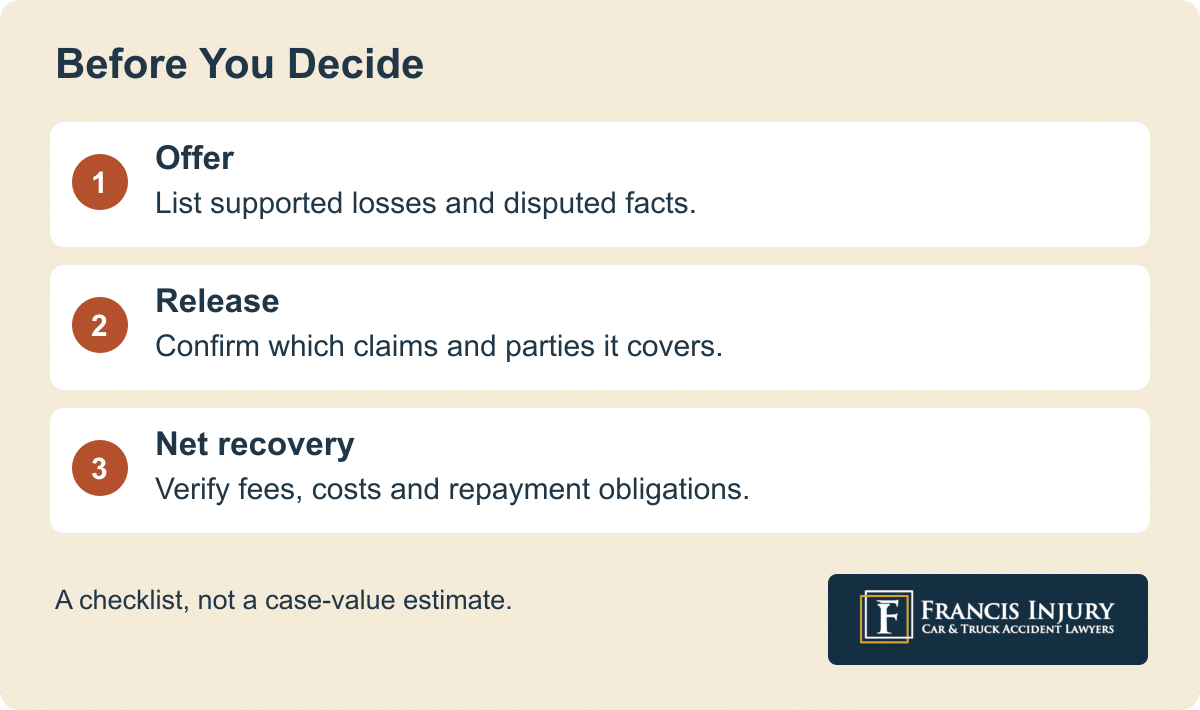
Start with the offer and draft release themselves. Do not rely on a phone description of what the paperwork says. Ask for clarification of anything that changes who is paid, which claims end or what you must do before payment.
- Medical outlook: What treatment has occurred, and what future care does a treating professional reasonably anticipate? An unresolved prognosis should be identified, not assigned an arbitrary dollar value.
- Income loss: Match missed work to employment records. Keep future earning limitations separate from pay already lost.
- Fault: What evidence supports each account of the crash? Preserve photographs, video and witness details using our personal injury evidence checklist.
- Coverage: Which policies, limits and potentially responsible parties have been investigated? A limit on one policy is not a valuation of every loss.
- Release scope: Does the agreement resolve vehicle damage, bodily injury, or both? Which people and entities are released?
- Money to you: What fees, case expenses and valid repayment obligations will be deducted?
The Texas Department of Insurance’s auto insurance guide explains coverage differences, including collision, personal injury protection and uninsured/underinsured motorist coverage. Review the actual policies before relying on another source of payment. Coverage, exclusions and claim requirements can change the available options.
When future treatment is still uncertain
Ask the treating professional what is known, what remains uncertain and whether future care can be estimated. That does not mean waiting indefinitely to act. A filing deadline can arrive before recovery is complete. Discuss preserving the claim while medical evidence develops, rather than choosing between a rushed release and missing a deadline.
Shared fault can change the negotiation
Under Texas Chapter 33, a claimant is generally barred from recovery when their responsibility is greater than 50%. At 50% or less, recoverable damages are reduced by that percentage. An adjuster’s assertion of fault is a position to evaluate against evidence, not a binding court finding.
Illustration: If otherwise recoverable damages were $80,000 and the claimant’s responsibility were 25%, the reduction would be $20,000, leaving $60,000 before other applicable limits or deductions. Those assumed figures explain the rule; they do not predict a settlement.
Compare the gross offer with the money you keep
A settlement offer is usually a gross figure. Use your signed fee agreement and actual case records to request a written distribution estimate. Do not subtract the same medical bill twice or assume that every payment by a health insurer creates an identical repayment obligation.
| Item | Assumed amount |
|---|---|
| Gross settlement | $60,000 |
| Assumed attorney fee | −$20,000 |
| Assumed case expenses | −$3,000 |
| Assumed verified medical repayments | −$12,000 |
| Illustrative remainder | $25,000 |
If a deduction is unresolved, label it pending and compare a range of possible remainders. Ask who will verify the obligation and whether it can be negotiated. Our Texas loss worksheet helps organize losses; it does not set the case’s value or replace a distribution statement.
Lump sum or scheduled payments?
How money is paid is a separate question from how the dispute is resolved. If a proposal uses scheduled payments, compare the dates and amounts with immediate bills and reasonably anticipated care. Ask who is obligated to pay, what happens if circumstances change and what terms restrict access to the money. A larger total paid over many years is not the same as the same amount available today.
For certain personal-injury suits involving incapacity or substantial disablement, Texas Chapter 139 requires a structured-settlement offer to be written and presented through the claimant’s attorney. That rule does not apply to every crash settlement. Review any proposed arrangement with qualified legal and financial advisers before agreeing.
If you have received an advance against a potential recovery, include its actual payoff terms in the distribution estimate. Compare costs using the agreement itself. Do not treat advertised funding as free money or as proof that the claim will succeed.
Turn disagreement into specific questions
A counteroffer is more useful when it answers the reason for the low valuation. If the insurer disputes missed work, provide employer records. If it questions future care, obtain the treating professional’s supported explanation. If it disputes fault, identify the missing evidence rather than simply repeating your account.
Keep a list of what was sent, when the insurer received it, and which questions remain unanswered. The broader guide to disputing an insurance claim can help you prepare for that discussion. A refusal to increase an offer is not, by itself, proof of unlawful conduct.
Check filing and notice deadlines while talks continue. Waiting for another offer is not a substitute for preserving a claim. Our Texas car accident deadline guide explains the ordinary two-year rule and why exceptions, service requirements and government notices need individual review.
Questions about settlement decisions
Should I automatically reject the first offer?
No. Evaluate its support and terms. The order in which an offer arrives does not establish whether it is reasonable. Missing medical information, disputed responsibility or a broad release are reasons to investigate before deciding.
Can I settle vehicle damage while the injury claim continues?
The claims may be handled separately, but the written release controls what you are giving up. Ask counsel to check that the document does not also resolve injury claims you intend to keep open.
Does an agreement at mediation matter before a check arrives?
Yes. Payment timing and whether an agreement binds the parties are separate questions. Section 154.071 provides that a written settlement executed through alternative dispute resolution is enforceable like another contract. Have the actual document reviewed before signing; do not assume the absence of a check means you can cancel.
Can I reopen the case if treatment costs more later?
A binding settlement and release can prevent additional recovery for the released claims. Do not assume you can return for more money. See what reopening a settled claim involves before signing.
Is there a typical amount I should demand?
An online average does not account for your evidence, available insurance, responsibility or deductions. Use documented losses and case-specific advice. Do not choose medical treatment to increase a settlement figure.

