
Originally published September 24, 2021. Updated October 10, 2026.

A car accident settlement calculator can add up figures you enter. It cannot decide what your Texas injury claim will settle for. Liability, medical evidence, future care, available insurance and the terms of a settlement all require more than arithmetic.
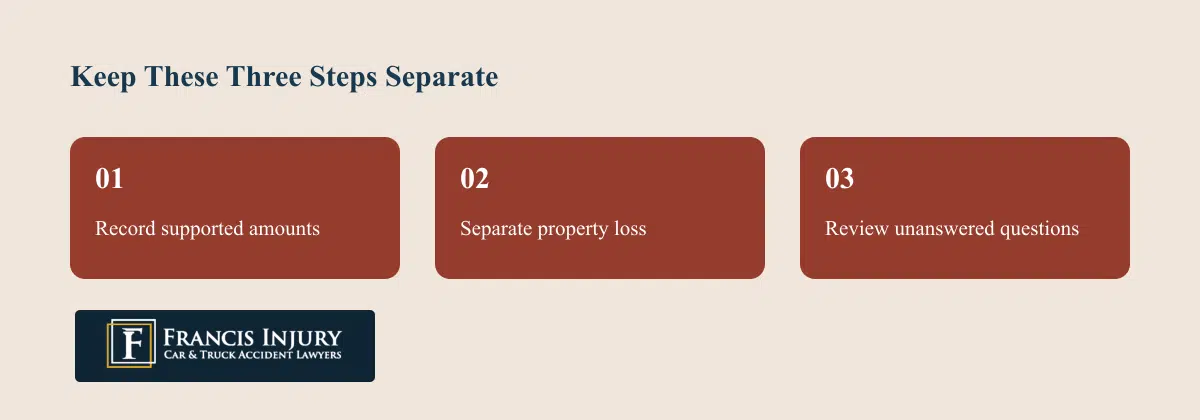
Use the worksheet below to organize documented losses before a conversation with a lawyer. It provides a subtotal of the amounts you enter, not a predicted payout, settlement offer or amount you will take home. There is no pain-and-suffering multiplier and no email requirement.
Start with a documented-loss worksheet
Keep each category separate and count each expense once. Use records you can explain rather than a guess at what an insurer will pay. The Texas Department of Insurance’s auto insurance guide explains the importance of medical reports, bills and other claim records, and how coverage limits affect payment.
Documented amounts only. Enter one reconciled amount per category. Use 0 only when that category is known to be zero; leave unknown amounts blank. Blank categories will be listed as incomplete. Do not enter names, diagnoses or other personal details.
This worksheet processes entries in this browser only. It does not save or send them. Results exclude future losses, non-economic damages, fault allocation, coverage, fees and reimbursements. No combined “settlement value” is calculated.
JavaScript is off. Add medical, income and other documented expenses manually; keep property loss separate. Neither subtotal predicts recovery.
| Category | Records to gather | What to check |
|---|---|---|
| Medical expenses to date | Itemized bills, receipts and explanations of benefits | Charges, payments, adjustments and balances differ. Do not add the same bill and its payments together. |
| Income already lost | Pay records, missed-work dates and employer confirmation | Separate verified lost earnings from an estimate of future earning capacity. |
| Other documented expenses | Receipts and a short explanation of each item | Record why the expense relates to the crash; inclusion in your notes does not establish recoverability. |
| Vehicle/property loss | Repair estimates, valuation and payment records | Track this separately from bodily injury; avoid adding both repair cost and total-loss value for the same vehicle. |
For incurred medical expenses, Texas Civil Practice and Remedies Code §41.0105 limits recovery to amounts actually paid or incurred by or on behalf of the claimant. A stack of original billed charges is therefore not automatically the recoverable amount. Have your lawyer reconcile the records rather than simply adding every number on every statement.
What a calculator cannot decide
Whether liability can be proved
The amount of your bills does not establish who caused the crash. Disputed movements, witness accounts and other evidence can change the assessment. Our car-accident evidence guide explains useful categories of proof.
Under Texas Chapter 33, a claimant’s responsibility generally reduces recoverable damages in claims covered by that chapter, and responsibility greater than 50% bars recovery. A calculator cannot establish that percentage. Several people may share responsibility; the rule is not simply a comparison between you and one other driver.
Future medical care and work limitations
A proposed surgery, ongoing rehabilitation or a lasting work restriction needs supporting evidence. Putting an arbitrary future amount into a calculator can conceal the uncertainty instead of resolving it. List the unanswered questions and bring treatment recommendations to your lawyer. See our explanation of medical documentation for related records to organize.
Pain, suffering and the effect on daily life
There is no reliable personal valuation here from multiplying bills by a number between one and five. Two people with similar bills may have very different injuries, limitations and evidence. This worksheet intentionally does not assign a dollar figure to pain, impairment or other non-economic losses. Describe the actual effects for a case-specific assessment.
The worksheet does not price family relationship losses; those require a separate legal analysis.
Coverage, deductions and the release
Available insurance, other potential sources of recovery, reimbursement obligations, fees and costs may affect what is collectible or ultimately received. A subtotal does not account for those issues. TDI also advises considering future treatment before signing an injury release. Ask what the proposed release resolves before accepting an offer.
Before comparing an offer with your losses, review the Texas settlement options and release checklist to separate the gross figure from the amount you may keep.
Worked example: why the subtotal is not the settlement
Illustrative figures, not a client result: suppose the records you have organized show $8,000 in medical expenses, $2,400 in lost income and $200 in other expenses. The entered injury-related subtotal is $10,600. If you separately record $3,000 for vehicle loss, that remains a separate property figure.
The worksheet has not valued pain or future care, established fault, reconciled medical billing under Texas law, checked coverage, or deducted fees or reimbursement obligations. Those omissions are why labeling $13,600 as an “expected settlement” would be misleading. The useful result is an organized list of figures and questions.
TDI explains that vehicle payments are generally limited by actual cash value rather than the cost of a brand-new replacement. Keep the insurer’s valuation and your supporting comparisons with the property records, separate from the injury discussion.
A double-counting check: a $1,000 bill and a separate receipt for a $200 payment toward that bill are not $1,200 in expenses. Keep both records, identify the remaining balance and adjustments, and ask which amount belongs in the medical-expense analysis. This bookkeeping example does not decide the amount recoverable under Texas law.
Questions to bring to a settlement discussion
- Which amounts are documented, and which are still estimates?
- Do the medical statements duplicate charges or include adjustments?
- What treatment or work limitations remain unresolved?
- What evidence supports the proposed allocation of responsibility?
- Which policies or other sources of recovery have been investigated?
- What fees, costs or reimbursement obligations would reduce the amount received?
- Which claims would the release close?
Settlement timing is a separate question. Read our Texas car-accident claim timeline guide for that discussion. A fast answer from a calculator does not mean a claim is ready to resolve.
Frequently asked questions
Does the worksheet tell me what to demand?
No. It totals entered figures and separates injury-related items from property loss. It does not recommend an offer or demand.
Should I enter bills already paid by insurance?
Keep those records, including adjustments and payment details, for review. Do not count a charge again merely because another document shows a payment toward it. Your lawyer can assess the recoverable amount and any reimbursement issue.
Why is there no multiplier?
A preset multiplier would produce an appearance of precision without examining your injuries or evidence. The worksheet is more useful when it shows exactly what it does and leaves individual valuation to a proper review.
Is this legal advice or an attorney-client relationship?
No. This is general information and an organizational aid. Using it does not create an attorney-client relationship or establish entitlement to compensation.
 Created with todds.ai

