
Originally published March 3, 2020. Updated October 10, 2026.
Loss of consortium in Texas concerns harm to a protected family relationship after an injury. Spouses and some children may qualify; parents cannot bring the same claim after a child’s nonfatal injury. Eligibility depends on the facts and law.
A spouse may have a claim, and a minor or adult child may qualify when a parent suffers a serious, permanent and disabling injury. This claim addresses changes in companionship, affection and other protected parts of the relationship. It is not a general payment for being upset about an accident. When someone has died, Texas wrongful-death law provides a separate framework that also needs to be considered.
Who can bring a loss-of-consortium claim in Texas?
The answer depends on the relationship and whether the injured person survived. Texas court decisions draw distinctions that a general definition can miss.
| Relationship and event | Texas distinction | Primary authority |
|---|---|---|
| A spouse is injured. | The uninjured spouse may have a claim for harm to the marital relationship. | Whittlesey v. Miller |
| A parent has a serious, permanent and disabling injury. | A minor or adult child may have a parental-consortium claim. | Reagan v. Vaughn |
| A child suffers a nonfatal injury. | The Texas Supreme Court declined to recognize the parent’s loss-of-consortium claim. | Roberts v. Williamson |
| A spouse, child or parent dies from a wrongful injury. | The surviving spouse, children and parents are the statutory wrongful-death beneficiaries. The claim must be evaluated under that framework. | Texas Civil Practice and Remedies Code §71.004 |
These are different legal paths, not interchangeable labels. A parent grieving a child’s death and a parent caring for a child who survived a disabling injury do not have the same consortium claim under Texas law. Other potential claims need their own analysis.
For a fatal injury, our guide to wrongful-death compensation provides related context. An unmarried partner or sibling should not assume eligibility from a general reference to “close family.”
What does the claim cover?
In Whittlesey, the Texas Supreme Court recognized the spouse’s interest in the marital relationship, including affection, companionship, comfort and sexual relations. The claimant needs to show how the injury harmed that relationship, rather than relying only on a diagnosis or the amount of the injured person’s medical bills.
For a child, Reagan addresses the loss of a parent’s love, affection, protection, emotional support and companionship following a qualifying disabling injury. The child’s age and the actual relationship are relevant to the evidence; adulthood alone does not exclude the claim.
Household services are a separate category
Do not label every family expense “consortium.” In Whittlesey, the court distinguished the intangible marital relationship from household services, a separate category of loss. Paid help, lost income and medical costs should be recorded separately and reviewed for their proper treatment. That distinction helps prevent the same loss from being counted twice.
Use specific before-and-after evidence
An honest description of changed daily life is more useful than dramatic language. Record what happened, when it changed and how you know. Medical evidence can help connect limitations to the injury; witnesses should describe things they actually observed.
- Shared activities: routines, conversations or time together that changed after the injury.
- Parent-child involvement: how a parent’s capacity for guidance, emotional support or participation changed.
- Duration: whether the limitation is temporary, ongoing or medically expected to continue.
- Other explanations: relevant pre-existing limitations or relationship difficulties. An accurate record includes facts that complicate the claim.
Save existing photographs, calendars and communications without altering them. Our personal injury evidence checklist explains how to organize records and preserve their sources.
A before-and-after relationship worksheet
Use this privately to organize a discussion with counsel. It is not a damages calculator, and a personal note is not automatically privileged just because it concerns a lawsuit.
| Record | Useful detail | Avoid |
|---|---|---|
| Relationship activity before injury | A specific routine and how often it occurred. | Claiming every day was perfect. |
| What changed afterward | An observed limitation, approximate date and present status. | Diagnosing a condition yourself. |
| Supporting source | A calendar entry, existing photograph or firsthand witness. | Editing records or coaching testimony. |
| Connection to the injury | Questions for the treating provider and lawyer about cause and prognosis. | Assuming every later change was caused by the crash. |
| Other losses | Track bills, earnings and replacement services separately for legal review. | Counting the same loss twice under different names. |
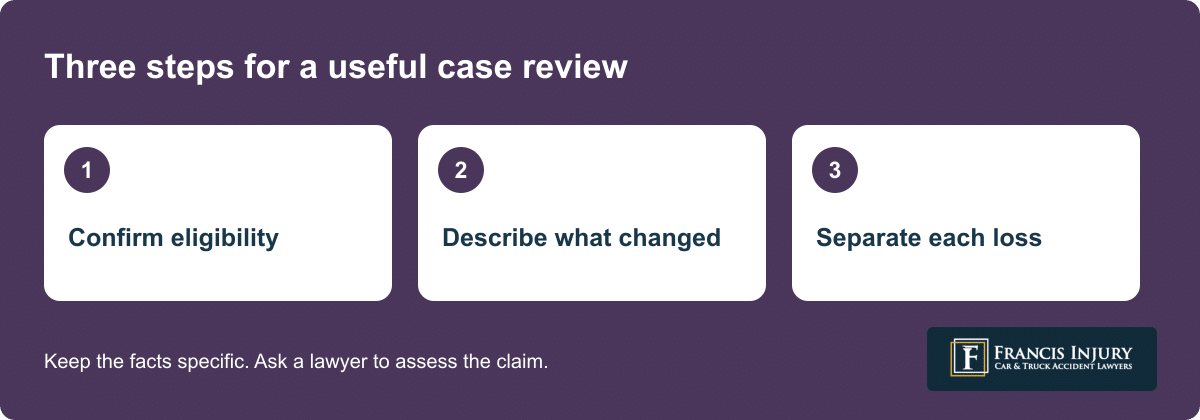
Example: describing a change without inventing a dollar value
Suppose a parent with a serious, permanent disabling injury can no longer take part in a longstanding weekly conversation and activity with an adult child. The child records the former routine, the change and who observed it. That may help counsel evaluate a parental-consortium claim; it does not prove eligibility or establish an amount by itself.
Keep that relationship evidence separate from receipts and wage records. Our guide to medical documentation and documented-loss worksheet address other parts of organizing a claim.
A separate claim still depends on the underlying case
A consortium claim belongs to the eligible family member, but it is derivative: the underlying injury must support legal liability. Defenses and responsibility issues in that case can affect the consortium claim. Reagan explains that connection.
Deadlines also require coordinated review. Texas Chapter 16 supplies general limitations rules, but the claim, accrual date, claimant and any applicable exceptions must be assessed. Do not wait for the injured person’s case to finish before asking about the family’s claims.
Review settlement releases for each claimant
Do not assume settling the injured person’s case automatically resolves every spouse’s claim—or that every relative’s claim necessarily survives a release. Whittlesey treated the spouse’s consortium claim as separate and examined the release and authority to settle it. Have counsel identify each claimant, the claims being resolved and the actual release language before anyone signs.
What would useful witness evidence look like?
Hypothetical example: “Before the injury, I joined them for a Sunday walk most weeks. Since the injury, I have visited them at home, and they have not been able to take those walks together.” That describes a routine, a change and the witness’s own observations. “Their relationship is ruined” gives counsel little to investigate.
A relative or friend should give their own account, without being coached to adopt this example. Record when they observed the change and how often they saw the family; leave diagnosis and prognosis to qualified medical evidence. In Reagan v. Vaughn, the court identified the injury’s actual effect on the parent-child relationship and the nature of that relationship among the factors a jury may consider.
Questions families often ask
Is loss of consortium the same as pain and suffering?
No. The injured person’s pain and suffering and an eligible relative’s loss of a protected relationship are different losses. Evidence should identify whose harm is being claimed.
Can an adult child qualify?
Potentially. Reagan v. Vaughn does not limit the recognized parental-consortium claim to minor children. The qualifying injury and loss still need proof.
Can a parent claim consortium if a child survives?
Roberts v. Williamson declined to recognize that parental claim for a nonfatal injury. That does not decide every other possible claim or the different rules that apply after a death.
Is there a standard settlement amount?
No useful amount can be calculated from the family relationship alone. The facts, proof, underlying liability and applicable legal limits matter. A multiplier of medical bills would not establish this loss.
For help evaluating a serious-injury claim, see how our Fort Worth personal injury lawyers team approaches these cases.
General Texas legal information, not advice for a particular case. This article does not create an attorney-client relationship.

