
Restored October 15, 2026. Originally published May 11, 2025.
What is considered reckless driving in Texas? The law describes driving with a willful or wanton disregard for the safety of people or property. Dangerous speed, deliberate brake-checking or weaving through traffic may support that finding, but no single label proves the offense or establishes an injured person’s claim.
After a crash, it is more useful to record what the driver did than to argue over the word “reckless.” The same collision can raise different questions for police, an insurance adjuster and a civil court. Each needs evidence, and a criminal charge is not a substitute for documenting your injuries and losses.
The starting point is Texas Transportation Code § 545.401. It defines the offense and provides a misdemeanor penalty of up to $200, up to 30 days in county jail, or both. Other conduct can involve separate offenses; those are not the standard penalty for this section.
Examples of reckless driving: what needs to be shown?
These examples are reasons to investigate, not automatic legal conclusions. Conditions, the sequence of events and the driver’s conduct all matter. Describe the behavior you actually observed; do not invent a speed, an intention or a phone conversation you could not see.
| Observed behavior | What needs context? | Potential evidence |
|---|---|---|
| A driver weaves through closely spaced traffic | Lane position, available space and how other vehicles reacted | Original dashcam footage, witnesses and the crash diagram |
| A driver brakes sharply in front of another vehicle | Whether there was a legitimate hazard or an intentional maneuver | Video showing the period before braking, not just the impact |
| A driver enters an occupied intersection against a signal | Signal timing, visibility and each vehicle’s movement | Independent witnesses, available video and scene photographs |
| A vehicle travels unusually fast in rain or congestion | Actual speed, road conditions and the basis of any estimate | Qualified reconstruction, vehicle data where available and physical evidence |
Tailgating, racing and distracted driving can also matter. The legal question is not whether conduct appears on a list. It is whether the evidence supports the applicable standard. Our rear-end collision guide explains why even a familiar crash pattern should be examined rather than assumed.
Does speeding automatically count as reckless driving?
No specific “25 mph over” or “30 mph over” threshold appears in § 545.401. Speed is relevant, but the reckless-driving provision does not replace its safety-disregard standard with a fixed number. A speed allegation should identify its source and the surrounding conditions.
A momentary driving mistake can support a negligence claim without satisfying the criminal reckless-driving standard. Conversely, severe conduct may involve more than one offense. Avoid treating a speeding ticket, a criminal charge and a civil finding of gross negligence as interchangeable.
Illustrative example: A witness says a car was “flying” before a crash. That observation may help identify the vehicle and sequence, but it is not a measured speed. A better file keeps the witness’s exact account alongside any unedited video, road conditions and available reconstruction evidence. It labels what is known and what still needs checking.
Preserve evidence without putting yourself at risk
Get emergency help when needed. Do not chase a dangerous driver or stand in traffic to capture a plate. If you can safely record the location, direction of travel and vehicle description, those details can help police identify the incident.
- Keep original files. Save photographs and video without trimming away the moments before the collision. Record who supplied each file.
- Separate observation from inference. “The car crossed two lanes” is different from “the driver meant to hit me.”
- Identify possible evidence holders. Note nearby businesses or vehicles that may have recorded the crash. Ask a lawyer promptly about preservation; footage may not remain available.
- Keep injury and expense records. Medical documentation, time missed from work and repair records answer different questions from a driving video.
Use our personal-injury evidence checklist to organize the file. A lawyer can consider whether lawful requests, consent or court procedures are needed for vehicle, phone or business records. Do not access another person’s account or device yourself.
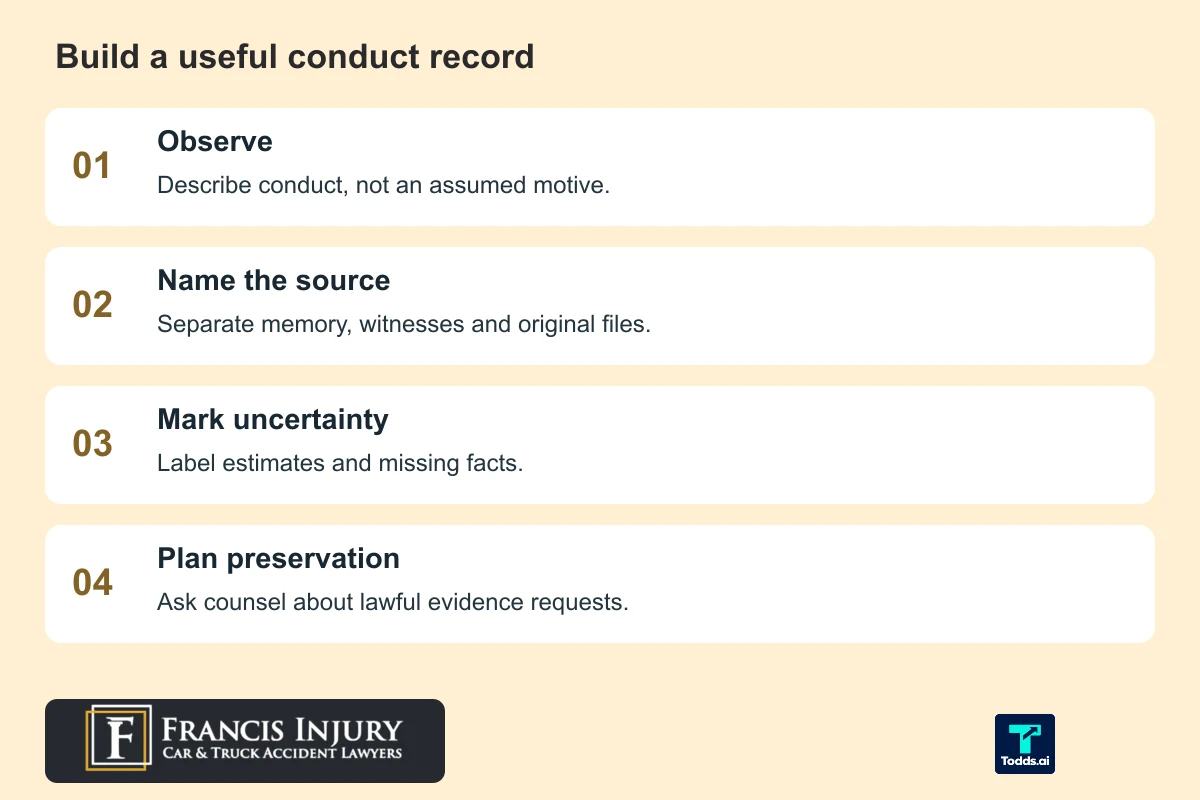
| Field | Example of a useful entry |
|---|---|
| Observed conduct | “The car crossed two lanes before impact,” rather than an unsupported motive |
| Source | My recollection, named witness or original video file; keep these separate |
| Missing fact | Speed is an estimate; no measurement is available yet |
| Next step | Identify the file holder and ask counsel about lawful preservation |
How reckless conduct affects an injury claim
A civil injury case ordinarily requires proof of responsibility, causation and compensable harm. It is not simply a request that the other driver be punished. Medical costs, lost income and other documented losses must be tied to the crash and evaluated under the applicable rules. Insurance coverage is another question: the driving label alone does not establish what a policy will pay. Ask the legal team to examine the evidence and coverage separately.
Exemplary damages are a separate issue. Texas Civil Practice and Remedies Code § 41.003 requires clear and convincing evidence of an applicable ground such as gross negligence; ordinary negligence is not enough. Calling someone reckless does not guarantee these damages, and further statutory requirements and limits can apply.
Your own conduct may also be disputed. Under Texas Chapter 33, a claimant’s percentage of responsibility can reduce damages, and responsibility greater than 50% bars recovery in cases covered by that chapter. See our comparative-negligence explanation for the distinction between an insurer’s position and a legal determination.
Keep the legal timetable separate from the criminal case. Our Texas car-accident filing-deadline guide explains why an open insurance claim is not the same as filing a lawsuit. Do not wait for a criminal outcome to ask about your civil deadline.
Questions about reckless driving in Texas
Must the other driver receive a ticket for me to pursue an injury claim?
A ticket is not a prerequisite to discussing a civil claim. Available evidence may still support negligence even when no citation was issued. The absence of a ticket does not decide fault.
Does a criminal conviction tell me what compensation I will receive?
No. Your injuries, proof, available coverage and applicable civil rules still need review. A criminal penalty is not a settlement valuation.
Can reckless driving happen in a parking lot?
Section 545.401 extends beyond highways to specified public places and business access or parking areas, with stated exclusions. Whether a particular location falls within the section requires checking its actual use and the statutory wording.
Should I confront or follow a reckless driver?
No. Prioritize getting out of danger and contacting emergency services when there is an immediate threat. A useful description can be provided without following the vehicle or escalating the encounter.
General Texas information, not advice for a particular case. Criminal defense questions should be discussed with an appropriate defense attorney.

