
Originally published June 25, 2024. Updated October 10, 2026.
Who pays for a rear-end collision in Texas? Fault and coverage determine payment. A rear impact alone does not prove fault; your auto insurance may help with bills.
The immediate problem is often practical: the car needs repairs, medical bills are arriving and the insurers disagree. Separate who caused the crash from which coverage can respond now. They are related questions, but they are not identical.
Is the rear driver always at fault?
No. Texas Transportation Code Section 545.062 requires a driver to maintain an assured clear distance, considering speed, traffic and road conditions, so the driver can safely stop without a collision or veering into another vehicle. Following too closely can support a negligence claim.
But the collision itself is not conclusive proof. In Jordan v. Sava, a Texas appellate court explained that a rear-end collision does not establish negligence as a matter of law. The circumstances and evidence still matter.
| Situation | What to investigate |
|---|---|
| A driver hits a vehicle stopped at a light. | Following distance, attention, braking and visibility. |
| A vehicle changes lanes immediately before impact. | Lane position, signals, timing and whether either driver could avoid the crash. |
| A middle vehicle is pushed into the car ahead. | The order of impacts and whether an earlier collision occurred before the push. |
| A brake-light or vehicle defect is alleged. | Inspection evidence and whether the claimed defect contributed; an allegation alone proves nothing. |
Sudden braking is not automatically negligence. Traffic can require an abrupt stop, and the following driver still has duties. Our guide to crashes involving multiple responsible drivers provides related context.
Who pays for a rear-end collision while fault is disputed?
The Texas Department of Insurance auto insurance guide distinguishes liability, collision, personal injury protection and uninsured/underinsured motorist coverage. Your declarations page and policy show what you actually have.
| Coverage | What it can address | Question to ask |
|---|---|---|
| At-fault party’s liability insurance | Covered injury and property losses, subject to liability, limits and policy terms. | Has the insurer accepted responsibility, and what documentation does it need? |
| Your collision coverage | Covered damage to your vehicle, usually less your deductible. | Can repairs proceed now, and how would any later deductible recovery work? |
| Your personal injury protection (PIP) | Covered medical expenses and specified income or service losses, regardless of fault. | What limit applies, and was PIP rejected in writing? |
| Your uninsured/underinsured motorist coverage | Qualifying losses involving an uninsured or inadequately insured responsible driver. | Which coverages, limits, deductibles and claim requirements apply? |
TDI explains that Texas policies include PIP unless it is rejected in writing. UM/UIM coverage must be offered and can also be rejected in writing. Neither coverage should be assumed from the fact that you bought an auto policy. See our related guide on an accident with an uninsured driver.
Do not simply subtract PIP from the other driver’s bill
A PIP payment does not justify an automatic dollar-for-dollar reduction of every liability claim. Texas Insurance Code Section 1952.155 addresses payment without regard to fault or collateral sources and limits PIP subrogation, with an exception involving a responsible person who lacked required financial responsibility. Coordination and reimbursement require review of the governing law and coverage. Ask for the basis of any proposed deduction instead of treating all insurance payments alike.
What if more than one driver shares fault?
Under Texas Civil Practice and Remedies Code Chapter 33, a claimant who is more than 50% responsible generally cannot recover damages in a negligence action. At 50% or less, the claimant’s percentage reduces the recovery. This does not mean an adjuster’s first proposed percentage is legally established.
Illustrative arithmetic: if damages were determined to be $20,000 and the injured claimant were 20% responsible, the reduction would be $4,000, leaving $16,000 before other applicable limitations or deductions. That is a demonstration of proportionate responsibility, not a settlement estimate or a prediction for your case.
The related Texas comparative-negligence guide covers this issue in more detail.
Who pays medical bills before a rear-end settlement?
Do not assume the other driver’s insurer will pay each treatment bill as it arrives. The Texas Department of Insurance explains medical-claim settlements and distinguishes PIP from medical payments coverage. MedPay can cover medical expenses; PIP also covers certain nonmedical losses. Your health plan may be another resource, subject to its terms.
- Ask what can be billed now. Give the provider accurate insurance details and ask the insurer what records it needs. Keep the bill and explanation of benefits together.
- Record what remains unpaid. Track each provider, service date, amount billed, payments and disputed balance. Share collection notices with your lawyer promptly.
- Check an agreement before signing. If a provider proposes deferred payment or a letter of protection, ask what you will owe if the claim recovers less than expected or nothing. Do not assume deferred payment means free care.
- Separate a settlement offer from take-home funds. Ask counsel to identify any claimed reimbursement, outstanding bills, fees and costs before you judge an offer.
There is no single payment order that fits every policy. Our guide to disputes with an auto insurer can help you organize the questions when a payment is delayed or denied.
Build a record that answers the disputed question
- Preserve the scene. If safe, photograph vehicle positions, damage, lane markings, signals and visible conditions. Never stand in traffic to obtain a photograph.
- Save video promptly. Keep original dashcam files. Identify nearby cameras, but do not assume a traffic camera records or that footage is retained.
- Record the impact sequence. Write down what you actually felt, heard and saw while it is fresh. Separate your observations from what another person told you.
- Collect witness and claim information. Save contact details, the report number, insurer correspondence and each adjuster’s explanation of a denial or fault allocation.
- Document medical care and losses. Keep treatment records, receipts, repair estimates and wage information. Avoid guessing about future costs or a diagnosis.
For a chain reaction, write down the sequence
In a hypothetical three-car crash, the middle driver feels a rear impact and then strikes the car in front. A useful note identifies whether the middle car was stopped, how many impacts the driver felt and what any video shows. That record helps investigate whether the middle car was pushed forward or had already collided. It does not automatically establish fault for any driver.
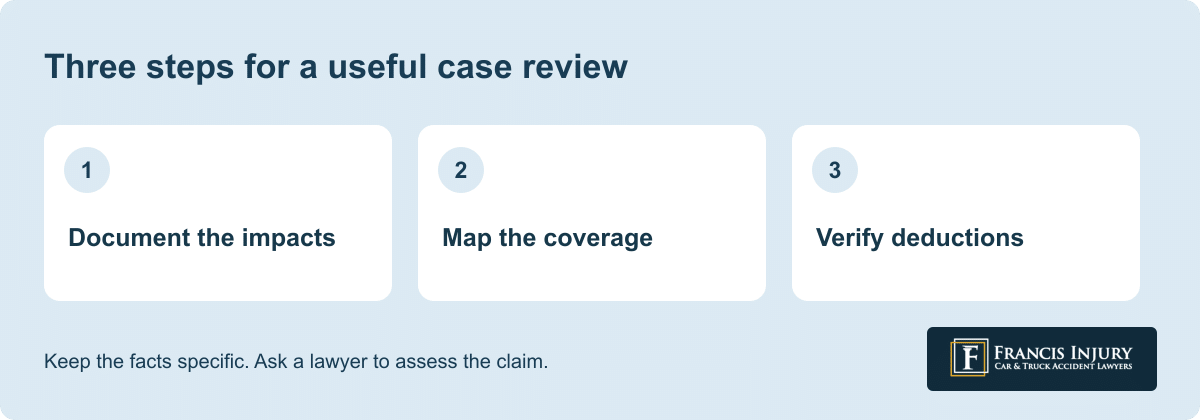
Our personal injury evidence checklist helps keep originals and sources together. The documented-loss worksheet can organize known expenses without pretending to calculate the value of pain, suffering or a final settlement.
Rear-end payment questions
Can I use my collision coverage if the other insurer has not accepted fault?
It may be available under your policy. Ask your insurer about the deductible, inspection and repair process. Do not assume the deductible will be refunded or that every expense is covered.
Does the police report decide who pays?
A report may contain useful evidence, but it does not by itself settle every disputed fact, legal issue or coverage question. Preserve the underlying photographs, witnesses and video too.
Is there a standard payout for a rear-end crash?
No reliable number follows from the collision type alone. The injury, evidence, responsibility, coverage and proven losses matter. Another firm’s case average is not an estimate for yours.
Should I accept a check while treatment continues?
Find out exactly what you are being asked to release. A vehicle-damage payment and a release of injury claims can have different consequences. Have unclear release language reviewed before signing.
For help evaluating a car-accident claim, see how our Fort Worth car accident lawyer team approaches these cases.
General Texas legal information, not advice for a particular case. Policy language and case facts control; this article does not create an attorney-client relationship.

