Truck accident cases in Texas can involve far more evidence than a typical passenger-vehicle collision. The truck driver may be only one piece of the investigation. The motor carrier, maintenance providers, cargo companies, other motorists, electronic logging systems, onboard cameras, and vehicle data can all provide important information about how and why a crash occurred.
Witness testimony can help connect those pieces of evidence. An eyewitness may describe a tractor-trailer drifting between lanes moments before impact. A responding officer may document conditions at the scene. An accident reconstruction expert may analyze physical and electronic evidence to determine vehicle speed and movement. A physician may explain how the collision caused an injury and what treatment may be necessary in the future.
For someone injured in a serious commercial vehicle collision, identifying the right witnesses—and preserving the evidence they may need—can become an important part of building a claim. The Texas Truck Accident Lawyers at Francis Injury investigate trucking collisions to determine what happened, who may be responsible, and what evidence can be used to establish liability and damages.
Why Are Witnesses Important in a Truck Accident Case?
Truck accident claims are often contested. The truck driver may describe the collision one way while the injured motorist remembers something entirely different. The trucking company’s insurer may dispute speed, braking, lane position, driver fatigue, the severity of the impact, or even whether the collision caused particular injuries.
Witnesses can provide evidence independent of either party’s version of events. Depending on the circumstances, testimony may help establish:
- What occurred immediately before the collision
- Which vehicle had the right of way
- Whether the truck was speeding or following too closely
- Whether the truck changed lanes unexpectedly
- Whether the driver appeared distracted or fatigued
- Road, traffic, lighting, and weather conditions
- Statements made immediately following the collision
- The severity of the impact
- The condition of the vehicles and roadway
- The injured person’s condition immediately after the crash
Witness testimony can become even more useful when attorneys compare it with objective evidence such as photographs, surveillance footage, electronic logging information, vehicle data, inspection records, and physical evidence from the accident scene.
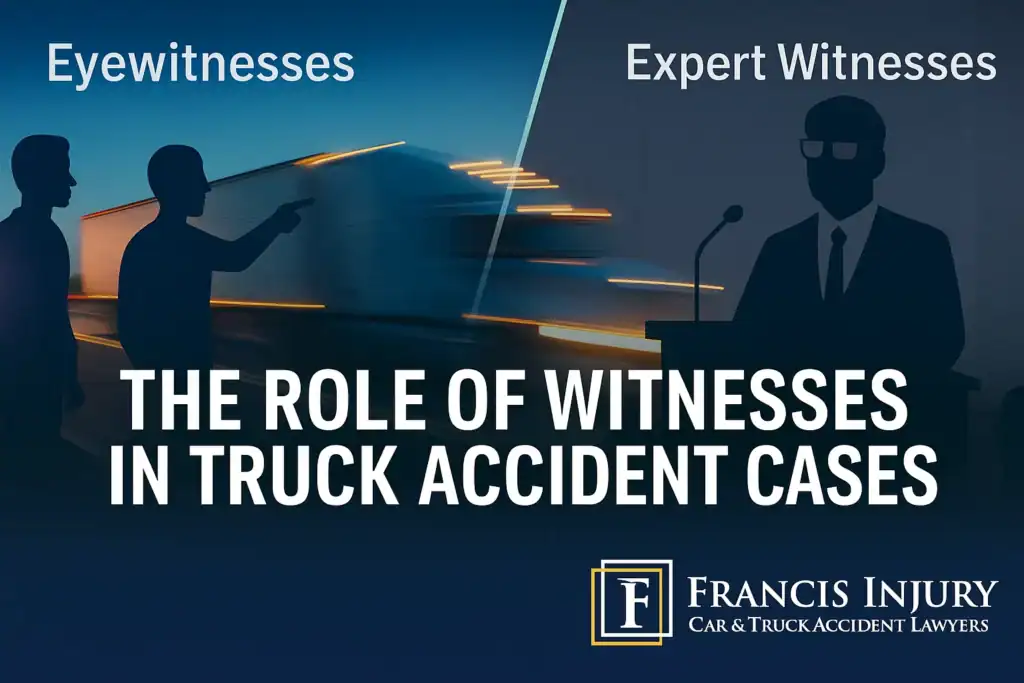
What Is the Difference Between an Eyewitness and an Expert Witness?
Truck accident cases can involve several categories of witnesses. Two of the most important are fact witnesses and expert witnesses.
Eyewitnesses and Other Fact Witnesses
An eyewitness generally testifies about something he or she personally saw, heard, or experienced. For example, another motorist might testify that a tractor-trailer crossed the center line immediately before a collision. A passenger could describe what the injured driver was doing before impact. Someone working near the accident scene might have observed the truck traveling unusually fast.
Useful fact witnesses can include:
- Drivers and passengers
- Other motorists
- Pedestrians
- Nearby business employees
- First responders
- Police officers
- Tow-truck operators
- Coworkers
- Family members
- Employers
- Treating medical providers
Some witnesses provide evidence about liability, while others may provide evidence about damages. For example, a spouse may not know how the collision occurred but may be able to describe significant changes in the injured person’s physical abilities or daily activities following the crash.
What Can Eyewitnesses Establish After a Truck Crash?
A credible independent eyewitness can be extremely valuable when fault is disputed. Witnesses may observe conduct related to some of the common causes of truck accidents, including:
- Unsafe lane changes
- Speeding
- Following too closely
- Failure to yield
- Running a red light or stop sign
- Erratic driving
- Improper turns
- Failure to brake
- Driver distraction
- Signs of fatigue or impairment
A witness’s location and ability to observe the accident are important. Someone directly behind the tractor-trailer may have had an excellent view of its braking and lane movement but a poor view of the other vehicle. Another witness approaching from the opposite direction may have seen something entirely different.
Different accounts do not necessarily mean that one witness is being dishonest. Investigators can compare each person’s vantage point, opportunity to observe the collision, consistency, and account with the physical evidence.
Why Should Truck Accident Witnesses Be Contacted Quickly?
Witness evidence can become weaker with time. People forget details. Phone numbers change. Surveillance footage may be overwritten. Vehicles can be repaired or destroyed. Electronic information may eventually disappear under normal data-retention practices.
This can be particularly important in commercial trucking cases. Federal Motor Carrier Safety Administration regulations require motor carriers to retain drivers’ records of duty status and certain supporting documents for specified periods. For electronic logging device records, motor carriers generally must retain ELD records and supporting documents for at least six months. See the Federal Motor Carrier Safety Administration for additional information.
That does not mean every potentially valuable piece of trucking evidence will remain available indefinitely. An investigation may therefore include efforts to identify and preserve:
- Electronic logging device (ELD) records
- Engine control module or ECM data
- Event data recorder information
- Dashcam video
- Nearby surveillance video
- Dispatch communications
- GPS and telematics information
- Driver qualification records
- Inspection and maintenance records
- Bills of lading and cargo records
- Cellphone evidence when legally obtainable
- Photographs and videos from the scene
- Witness contact information and statements
Witnesses become even more useful when their accounts can be compared against objective evidence. For example, a witness who says the truck never appeared to brake may provide an important investigative lead. Vehicle data, roadway evidence, and accident reconstruction may then help determine whether that observation is consistent with what occurred.
What Is the Role of Expert Witnesses in a Truck Accident Case?
Some issues in a commercial trucking case cannot be adequately explained by an ordinary eyewitness. This is where expert witnesses may become important.
Under Texas Rule of Evidence 702, a witness qualified through knowledge, skill, experience, training, or education may provide expert testimony when scientific, technical, or other specialized knowledge will help the trier of fact understand the evidence or determine a fact in issue.
Not every truck accident requires every type of expert. The appropriate experts depend on the facts of the collision and the issues actually being disputed.
Accident Reconstruction Experts
Accident reconstruction specialists may analyze evidence such as:
- Vehicle damage
- Tire and roadway marks
- Final resting positions
- Crash photographs
- Vehicle measurements
- ECM or event data
- Video footage
- Roadway geometry
- Vehicle speed and movement
They may use this information to reconstruct how the collision occurred and evaluate competing explanations of the crash.
Trucking Safety Experts
A trucking safety expert may evaluate whether a driver or motor carrier complied with applicable federal trucking regulations and accepted industry safety practices.
Relevant issues may include:
- Hours-of-service compliance
- Driver qualification
- Driver training and supervision
- Vehicle inspection
- Maintenance practices
- Cargo securement
- Company safety procedures
For many property-carrying commercial drivers, federal hours-of-service rules generally allow up to 11 hours of driving after 10 consecutive hours off duty and prohibit driving beyond the 14th consecutive hour after coming on duty, subject to applicable exceptions and other requirements. Current regulations are available through the FMCSA Hours of Service Regulations.
If driver fatigue is suspected, witness testimony, electronic logs, dispatch information, GPS records, and other evidence may become important in determining what happened.
Medical Experts
Medical testimony can address issues such as:
- The nature and severity of an injury
- Whether the collision caused or aggravated the condition
- Necessary medical treatment
- Future medical care
- Permanent limitations
- Disability
- Long-term prognosis
These opinions may also become relevant when determining what factors affect the value of a truck accident case.
Economists and Vocational Experts
When serious injuries interfere with a person’s ability to work, vocational and economic experts may evaluate:
- Lost wages
- Reduced earning capacity
- Employment limitations
- Future economic losses
- The financial effect of permanent disability
Other Types of Expert Witnesses
Depending on the circumstances, a truck accident case could also involve engineers, biomechanical experts, medical specialists, life-care planners, transportation specialists, or other qualified professionals. The expert should fit the disputed issue rather than simply being added because the case involves a commercial truck.
How Do Witnesses Work With Electronic and Physical Evidence?
A modern truck accident investigation is rarely based on testimony alone. Witness accounts can be compared with physical and electronic evidence to create a more complete picture of what happened.
Consider a disputed lane-change accident. An eyewitness might say the truck moved suddenly into another lane. Dashcam footage might capture part of the maneuver. ECM data could provide information about speed or braking. GPS information could establish the truck’s movements. Vehicle damage and roadway evidence may help an accident reconstruction expert determine where the impact occurred.
Each source of evidence can corroborate—or contradict—the others. This combination may provide a much stronger basis for determining liability than relying on any single piece of evidence.
What Happens If Witnesses Give Conflicting Accounts?
Conflicting witness accounts are common after serious collisions. A truck accident may happen in only a few seconds, and witnesses often observe it from different locations and angles.
Attorneys and investigators may evaluate:
- Where the witness was positioned
- What the witness could actually see
- Whether anything obstructed the witness’s view
- Lighting and weather conditions
- The witness’s attention immediately before impact
- Whether the account changed over time
- Whether physical or electronic evidence supports the testimony
- Whether the witness has a relationship with one of the parties
A jury may ultimately decide how much weight to give a particular witness. This is one reason independent physical and electronic evidence can be so valuable. Photographs, video, electronic records, vehicle damage, and reconstruction analysis may help determine which description of the accident best fits the available evidence.
How Can Witness Testimony Affect Fault Under Texas Law?
Witness testimony may become especially important when the parties disagree about how responsibility for a collision should be divided.
Texas uses a proportionate responsibility system. Under Chapter 33 of the Texas Civil Practice and Remedies Code, a claimant generally may not recover damages when his or her percentage of responsibility is greater than 50 percent. When recovery is permitted, damages may be reduced according to the claimant’s assigned percentage of responsibility.
That makes evidence regarding the conduct of every driver involved important. For example, a trucking company’s insurer might argue that an injured motorist:
- Changed lanes improperly
- Was speeding
- Failed to maintain a proper lookout
- Followed too closely
- Failed to take reasonable evasive action
Independent witnesses and objective evidence may help support or challenge those allegations. For a broader discussion about establishing fault, read our guide to truck accident negligence.
What Happens During a Witness Deposition?
If a lawsuit is filed, witnesses may be questioned under oath during the discovery process. A deposition allows attorneys for the parties to learn what a witness knows and preserve testimony before trial.
Questions may address:
- What the witness observed
- Where the witness was located
- Conditions at the scene
- Statements made following the collision
- Previous statements given to investigators
- Photographs or videos the witness possesses
- The evidence reviewed by an expert
- The basis for an expert’s opinions and conclusions
Expert depositions can become substantially more technical and may address methodology, calculations, assumptions, supporting evidence, and competing expert opinions. Learn more about litigation and discovery in What Happens in a Car Accident Lawsuit?
Do Witnesses Have to Testify at Trial?
Not necessarily. Many personal injury cases are resolved before trial. However, attorneys may still prepare the case with the possibility that important witnesses will eventually testify before a judge or jury.
If a truck accident case proceeds to trial, eyewitnesses may explain what they personally observed while qualified expert witnesses may help the jury understand technical evidence. Defense attorneys also have an opportunity to cross-examine witnesses and challenge their recollection, credibility, methodology, assumptions, or conclusions.
How Can Witnesses Affect a Truck Accident Settlement?
Insurance companies and defense attorneys evaluate the evidence they believe would be presented if a lawsuit proceeds to trial. A credible independent witness or well-supported expert opinion can strengthen a claim because it may make disputed facts easier to establish.
However, witnesses do not automatically increase the value of a truck accident case. An unreliable witness, inconsistent testimony, or an expert opinion that is poorly supported can create additional problems.
The goal is not simply to accumulate as many witnesses as possible. It is to identify credible witnesses whose testimony can be supported by the other evidence in the case.
For additional information about evaluating damages and settlement strategy, read Tips for Maximizing a Truck Accident Settlement.
What If There Were No Eyewitnesses to the Truck Accident?
The absence of an independent eyewitness does not necessarily prevent an injured person from establishing what happened. A commercial truck accident investigation may still rely on:
- Police reports
- Vehicle damage
- Crash-scene photographs
- Dashcam footage
- Traffic cameras
- Business surveillance cameras
- ECM or event data
- Electronic logging records
- GPS and telematics information
- Cellphone records when legally obtainable
- Inspection and maintenance records
- Accident reconstruction
In some cases, objective electronic and physical evidence may ultimately provide a clearer picture of the collision than eyewitness testimony alone.
How Can Francis Injury Investigate Witness Evidence?
Commercial truck accident investigations can require evidence from several different people, companies, vehicles, and electronic systems. Francis Injury investigates potential sources of evidence, identifies witnesses, obtains available records, and works with qualified experts when appropriate for the case.
An investigation may include:
- Identifying and interviewing eyewitnesses
- Obtaining available crash-scene evidence
- Seeking preservation of relevant electronic records
- Reviewing trucking company records and documents
- Evaluating applicable FMCSA regulations
- Consulting accident reconstruction specialists when appropriate
- Obtaining medical evidence
- Preparing witnesses for depositions
- Evaluating and challenging defense expert opinions
- Preparing evidence for settlement negotiations or trial
Every truck accident is different, which means the witnesses and evidence needed in one case may be very different from another.
If you were injured in a collision involving a commercial truck, call 817-329-9001 or contact Francis Injury online for a free consultation.
Francis Injury represents injured clients in Fort Worth, Dallas, Grapevine, Keller, and communities throughout Texas.
Frequently Asked Questions About Witnesses in Truck Accident Cases
Final Thoughts
Witness testimony can be an important part of establishing fault and damages after a serious commercial truck accident. Eyewitnesses can provide an independent account of what occurred, while qualified expert witnesses can help explain technical, medical, economic, and trucking-industry issues.
The strongest cases often do not rely on witness testimony alone. Attorneys can compare witness accounts with electronic logging records, vehicle data, photographs, video, physical evidence, medical documentation, and other information to develop a more complete understanding of the collision.
If you or a family member has been injured in a commercial truck collision in Texas, contact Francis Injury to discuss the circumstances of your case and the evidence that may be available.
- When Can a Child Sit in the Front Seat of a Car in Texas?

- Car Accident Lawyer in Arlington: Records, Costs & 7 Questions

- Negligence vs Intentional Wrongdoing in Texas
- What Is Considered Reckless Driving in Texas?
- Is It Illegal to Sleep in Your Car in Texas?
- Where Do Most Car Accidents Occur in Dallas, TX?
- Car Accident in a Friend’s Car: 5 Texas Coverage Checks

- Do Insurance Companies Pay for Pain and Suffering in Texas?
- Texas Insurance Claim Deadlines: 3 Payment Stages