
Published October 11, 2026.
Do insurance companies pay for pain and suffering? They can in a Texas injury claim, but payment depends on liability, available coverage and evidence of the harm. Medical bills alone do not establish the value of physical pain or emotional distress, and a settlement calculator cannot promise what an insurer will offer.
If an adjuster has offered to pay your bills but little else, start by identifying the policy involved and the losses the offer actually includes. Then assemble a clear account of what changed after the crash. The goal is an accurate, supported claim—not a larger number produced by a formula.
Which Insurance Might Pay for Pain and Suffering?
Pain and suffering describes nonfinancial harm rather than an invoice. Texas’s statutory definition of noneconomic damages includes physical pain, mental anguish, disfigurement and physical impairment. Naming those categories does not establish that every claimant can recover every category.
| Claim or coverage | Role in the claim | Question to resolve |
|---|---|---|
| Another driver’s bodily-injury liability coverage | May fund a covered injury settlement, including supported noneconomic losses. | Is responsibility disputed, and what coverage is available? |
| Uninsured/underinsured motorist bodily-injury coverage | May cover pain and suffering when an at-fault driver lacks adequate insurance. | Are you an insured person, and what conditions apply? |
| Personal injury protection or medical payments | Provides specified benefits such as medical expenses; PIP also includes certain nonmedical losses. | Which benefits have been paid, and under which policy? |
| Collision coverage | Addresses vehicle damage, not a pain-and-suffering award. | Is the offer for the car, the injury claim, or both? |
The Texas Department of Insurance specifically includes pain and suffering in its explanation of UM/UIM coverage. Its auto insurance guide explains the different roles of PIP, medical payments and collision coverage. Read the actual policy before assuming one benefit replaces another.
Keep separate folders for the car-damage claim and injury claim. If someone sends a document labeled “final settlement,” ask exactly which claims and people it releases before signing it. Our settlement-options guide provides a release and net-recovery checklist.
What Makes a Pain-and-Suffering Claim Supportable?
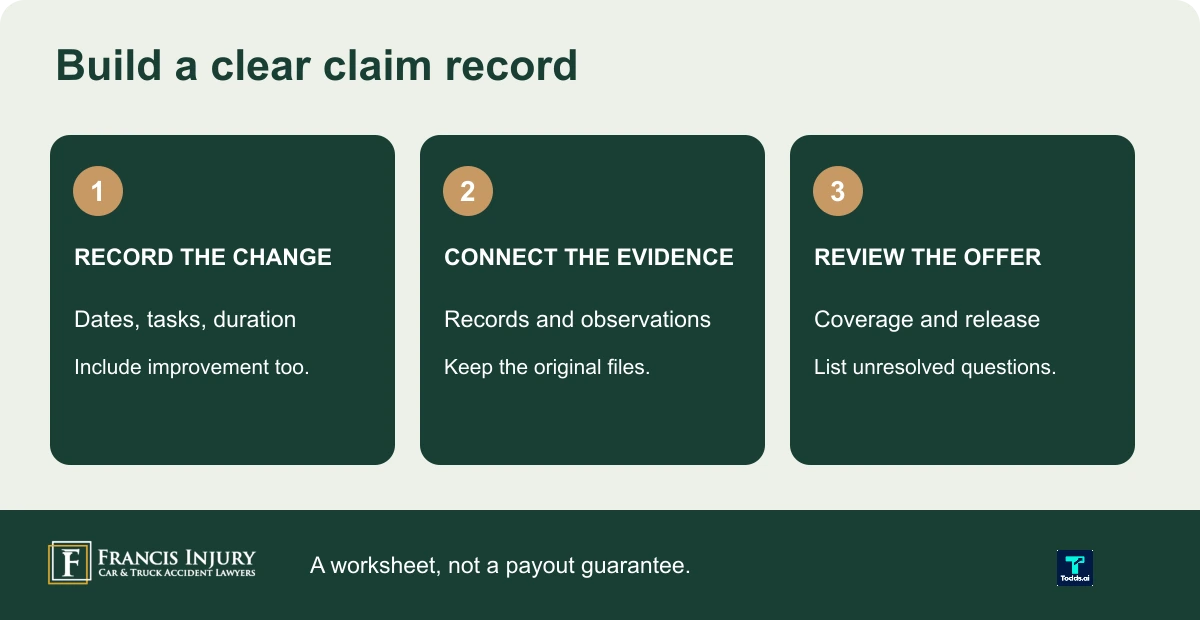
Describe an actual limitation, when it happened and what supports the account. “Everything hurts” gives an adjuster little to evaluate. “I stopped after ten minutes of preparing dinner because standing increased my back pain” identifies a task and an effect. It still needs to be truthful and consistent with the wider record.
- Medical records: preserve diagnoses, reported symptoms, treatment recommendations and follow-up notes. Report symptoms accurately; do not seek unnecessary care to build a claim.
- Before-and-after information: identify activities you could perform before the crash and how your ability changed afterward. Include relevant prior conditions.
- Contemporaneous notes: record significant changes while they are fresh. Include improvement and ordinary days as well as difficult ones.
- Independent observations: a relative or coworker may describe what they personally observed. Do not supply a script or ask someone to exaggerate.
- Duration and prognosis: distinguish an ongoing symptom from a clinician’s opinion about future limitations. Neither a diary nor an online article can diagnose permanence.
Use our Texas evidence checklist to organize the underlying records. Retain the originals and dates. If a note needs correction, add a dated clarification rather than silently rewriting the history.
A Worked Example: Turn a Vague Complaint Into a Useful Record
Illustrative example—not a Francis Injury client or a claim estimate. A driver reports shoulder pain after a collision. A useful entry might read: “Tuesday: stopped unloading groceries after two bags because lifting increased shoulder pain. My partner finished. Discussed the limitation at Thursday’s appointment.” That entry connects a date, task, observed effect and possible corroboration.
It does not assign a dollar amount. If the next week was better, record that too. If the same shoulder hurt before the crash, note the earlier symptoms and describe the change without assuming every problem came from the accident.
| Record | Your entry | Supporting item |
|---|---|---|
| Date and affected task | What were you trying to do? | Contemporaneous note or calendar entry |
| Specific limitation | What changed, and for how long? | Medical note or firsthand observation |
| Before the crash | What could you normally do? Any prior symptoms? | Relevant earlier records |
| Follow-up and improvement | What did your clinician recommend? What improved? | Visit summary or dated update |
Keep these records private and discuss appropriate sharing with your attorney. Ask your attorney how to keep and share relevant notes; do not assume a private label settles that question. Do not delete existing posts or messages; preserve them and ask counsel how to handle relevant material.
Why a Multiplier Is Not a Promised Payout
A multiplier applies a number to financial losses; a per-day approach assigns a daily amount over a period. You may encounter both during negotiation or online research. Neither turns your bills into a guaranteed Texas pain-and-suffering payment.
In the Texas Supreme Court’s Gregory v. Chohan decision, Justice Bland’s concurrence identified common ground: mental-anguish damages must rest on evidence, not unrelated yardsticks. That wrongful-death decision is not a settlement calculator. It illustrates why an arbitrary number cannot replace support for the claimed harm.
The missing step is the evidence explaining this person’s injury. Two people can incur similar bills but have different recoveries, treatment needs, work demands and limitations. An unsupported multiplier skips those differences. A larger bill also does not prove a more serious lasting effect.
For an offer review, separate the documented economic losses, the proposed amount for noneconomic losses and any unresolved facts. Our settlement loss worksheet helps organize known costs without predicting an award. Ask the adjuster which records were considered and what information remains missing.
Compare Earlier Symptoms With the Change After the Crash
Make two columns: what existed before, and what changed afterward. Record dates, affected tasks and relevant treatment in each. Ask your clinician to address medical causation rather than making that conclusion yourself. A complete history lets your attorney evaluate the claimed aggravation instead of discovering an unexplained discrepancy later.
What Can Reduce or Complicate Recovery?
Fault and coverage can limit a claim even when an injury is real. Under Texas Chapter 33, in cases governed by that chapter, a claimant more than 50% responsible cannot recover damages; a lesser responsibility percentage reduces recovery. A policy limit is a separate constraint on insurance payment.
This guide concerns injury claims after car accidents. Fear or upset alone does not automatically create a compensable claim. If you seek emotional-distress damages without a physical injury, the legal basis and proof need individual review.
Other issues include disputed causation, preexisting symptoms and whether future losses have adequate support. Claims involving government bodies or health-care liability can raise different restrictions. This car-accident guide is not a substitute for reviewing those special situations.
A delay in seeking advice can create another problem. Negotiating an offer and filing a lawsuit are different steps. Consult our Texas filing-deadline guide and have the applicable deadline checked rather than waiting for an insurer to finish discussions.
Five Questions Before Accepting an Offer
- Is this payment for property damage, bodily injury or both?
- Which losses and records were included in the evaluation?
- What medical uncertainties or future treatment remain?
- Which people, companies and claims would the release cover?
- What fees, expenses or valid repayment obligations affect the amount you receive?
Save the answers with the offer. An unexplained number is a reason to ask for an explanation, not proof of misconduct. If you decide not to accept, understand what refusing an offer can mean, including the time, cost and uncertainty of further negotiation or litigation.
Pain-and-Suffering FAQs
Can My Own Insurance Pay for Pain and Suffering?
Potentially, through applicable UM/UIM bodily-injury coverage when another driver is responsible and lacks adequate insurance. PIP and medical payments are different benefits. Ask which policy provision applies to the loss you are claiming.
Do I Need a Permanent Injury?
A claim can involve temporary physical pain. Permanence is not something to infer from a symptom that persists. The medical evidence, duration and effect of the injury matter; future-loss allegations need their own support.
Will a Pain Journal Guarantee More Money?
No. Accurate notes can help explain the experience and identify records to obtain. They do not guarantee payment, establish fault or replace medical evidence.
What if the Offer Only Lists My Medical Bills?
Ask whether it resolves the entire bodily-injury claim and request a breakdown. Review the release before treating the description on a check or email as the full agreement.
General Texas information, not advice for a particular claim. Coverage, evidence and applicable law must be evaluated for the individual case.
Prepared with