
Originally published August 1, 2023. Updated October 10, 2026.
The Texas car accident statute of limitations generally gives an injured person two years from the crash to file a lawsuit. Opening an insurance claim, sending a demand or negotiating a settlement is not the same as filing suit. Other notice requirements may expire sooner, and exceptions require a separate legal analysis.
If you were hurt around Fort Worth, Southlake or another DFW community, start by gathering the crash date, the parties involved and every letter from the insurers. Those facts help a lawyer check the deadlines that actually apply to your case.
Three different clocks can be running
Texas Civil Practice and Remedies Code Section 16.003 generally sets a two-year limitations period for personal injury and property damage. In an ordinary crash case, the injury claim usually accrues on the accident date. That is a starting point for review, not a deadline calculation for every claim.
| What needs attention | General rule | What to verify |
|---|---|---|
| Lawsuit against a private party | Usually two years from accrual for injury or property damage. | Correct defendants, applicable claims and timely service. |
| Notice to a government entity | A separate requirement may apply well before the lawsuit deadline. | Which entity is involved, its notice rules and any immunity issues. |
| Insurance-policy notice | Your policy can require prompt reporting and cooperation. | The actual policy wording; an open claim does not itself extend limitations. |
A crash involving a city vehicle, for example, deserves an immediate notice review. Under Section 101.101 of the Texas Tort Claims Act, notice is generally required within six months, and applicable city-charter provisions may require shorter notice. Exceptions and governmental immunity also matter. Six months is not a universal deadline for filing the lawsuit.
Our discussion of a car accident involving a government vehicle explains why identifying the owner early is important.
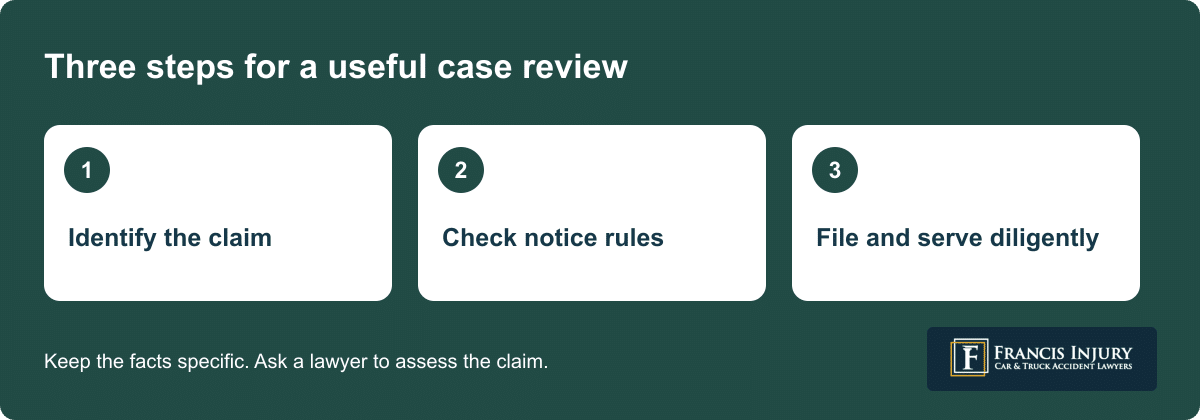
Filing suit and serving the defendant are different steps
Submitting a petition before limitations expires does not excuse an unexplained delay in serving the defendant. In Proulx v. Wells, the Texas Supreme Court explained that a plaintiff must exercise diligence in obtaining service. When service occurs after limitations, that diligence can determine whether service relates back to the filing date.
Keep a written record of the filing and service plan with your lawyer. Do not assume a claim number or an adjuster’s continuing correspondence means a lawsuit has been filed. The time needed to settle a claim and the time allowed to bring suit answer different questions.
Insurer response deadlines are separate from lawsuit filing deadlines. See our guide to insurance claim payment stages while continuing to protect the filing and service requirements discussed here.
Texas car accident statute of limitations: exceptions
Some exceptions pause the clock, a concept called tolling. Others affect when a claim accrues. Neither should be assumed just because an insurer is still investigating.
- A child was injured. Section 16.001 generally excludes time under a qualifying legal disability, including being younger than 18 when a claim accrues. A parent’s separate claim and other applicable requirements need their own review.
- The person had an unsound mind when the claim accrued. This is a legal standard under Section 16.001. Stress, hospitalization or a later diagnosis does not automatically establish it; a disability arising later does not automatically suspend the clock.
- An injury was discovered later. Texas applies the discovery rule narrowly. A later diagnosis is not an automatic new starting date. The Fifth Circuit’s discussion of Texas discovery-rule limits in Smith v. Travelers describes the requirements that an injury be inherently undiscoverable and objectively verifiable.
- A person died from the crash. Section 16.003(b) generally measures a wrongful-death claim from the date of death. Claims belonging to the injured person or estate require separate analysis.
Section 16.072 also addresses limitations periods ending on weekends or specified holidays. Give your lawyer the actual dates instead of relying on a calendar reminder generated from a general rule.
Does the clock stop if the other driver leaves Texas?
Do not rely on that assumption. Although Section 16.063 concerns absence from Texas, the Texas Supreme Court’s decisions in Ashley v. Hawkins and Ferrer v. Almanza explain why physical absence alone does not toll limitations when a defendant remains subject to Texas jurisdiction and available for service. Tell your lawyer about the move; do not add the time away to your deadline yourself.
A five-part deadline review checklist
This is an organizer for a legal consultation, not a substitute for calculating your deadline. Use it alongside our personal injury evidence checklist.
- Write down the dates. Include the crash, treatment, any death and each insurance or government notice. Keep copies showing when documents were sent or received.
- Identify everyone involved. Gather driver, owner, employer and government-entity information. Tell the lawyer what is unknown.
- Collect every policy and claim number. Include your own coverage and the other driver’s insurer. Preserve the actual letters, not just notes from phone calls.
- Ask about exceptions. Explain age, capacity and any unusual discovery issue. Ask which documents support an exception instead of assuming one applies.
- Confirm the next legal step. Ask counsel to identify the applicable deadlines, responsible person and filing/service plan. Follow up if you have no confirmation.
Example: an open insurance claim near the two-year mark
A hypothetical driver is still sending medical records to an adjuster 23 months after a crash. The adjuster asks for another update. That request does not, by itself, stop limitations. The useful next step is an urgent review of whether a lawsuit must be filed and how service will be pursued—not waiting to finish every settlement discussion.
Organizing expenses with our documented-loss worksheet can support that conversation, but completing a worksheet does not preserve a legal claim.
Should I wait until treatment ends to ask about filing?
No. Ongoing treatment and a lawsuit deadline need attention at the same time. Tell your lawyer which care is continuing, which records are outstanding and whether a doctor has discussed future treatment. Ask who is handling the filing and service plan while that information develops. Waiting for a final medical bill is not itself a tolling exception.
Likewise, do not assume the general two-year rule answers every dispute with your own insurer. Bring the policy and any denial letter so counsel can identify the claim being considered. This article addresses crash-injury deadlines, not a universal deadline for every insurance-contract dispute.
Questions about filing deadlines
Does filing an insurance claim stop the two-year clock?
No, not by itself. A claim, demand and lawsuit are different steps. Have counsel check any claimed extension against the actual facts and documents.
Must the case settle within two years?
Usually the relevant requirement is bringing the lawsuit within limitations, with diligent service—not obtaining a settlement by that date. A timely lawsuit can continue afterward.
What if the deadline appears to have passed?
Have a lawyer review it promptly. An exception may or may not apply. Do not assume an exception exists, and do not discard records because an online calculation says you are late.
For help evaluating a car-accident claim, see how our Fort Worth car accident lawyer team approaches these cases.
General Texas legal information, not advice for a particular case. This article does not create an attorney-client relationship.

