
Published October 10, 2026.
Texas insurance claim deadlines depend on whose policy is involved. For a covered first-party claim, payment is generally due within five business days after the insurer says it will pay. Earlier acknowledgment and decision deadlines have different triggers. The same timetable does not govern a claim against another driver’s insurer.
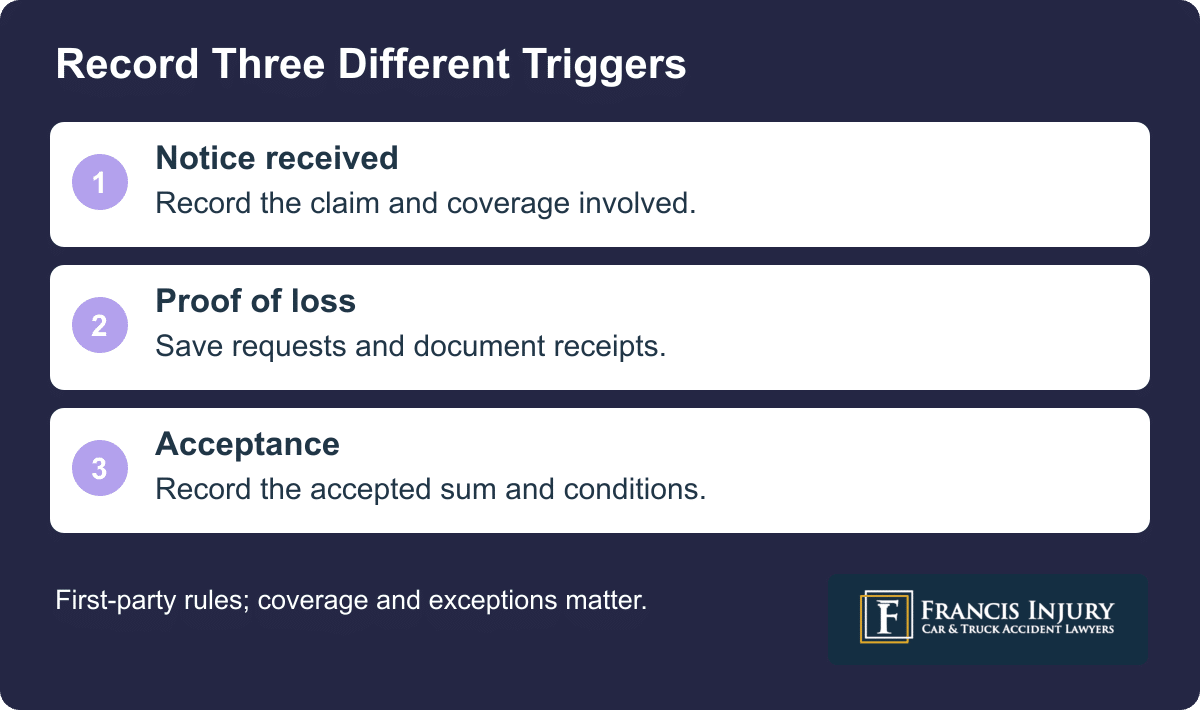
For a crash claim, start by identifying the policy and the benefit you requested. “It has been a month” is less useful than knowing when notice arrived, what documents were needed and whether any amount was accepted. Those facts determine which deadline needs review.
Your insurer and the other driver’s insurer follow different rules
A first-party claim seeks benefits under a policy covering you. A third-party liability claim seeks payment for harm caused by someone insured under another policy. A single crash can involve both: for example, a vehicle-damage claim under your own collision coverage and an injury demand involving the other driver’s liability insurance.
Texas Insurance Code §542.051 defines the claims covered by the prompt-payment subchapter as first-party claims meeting its requirements. The Texas Department of Insurance’s auto insurance guide expressly says the prompt-payment law does not apply when another driver’s insurer is paying your claim.
This does not give a liability insurer permission to handle claims unfairly. It means you should not treat the deadlines below as a guaranteed countdown to a bodily-injury settlement. Fault, the extent of injuries, policy limits and release terms can remain disputed.
Three stages of Texas insurance claim deadlines
The table summarizes the ordinary rules in §§542.055–542.057 for a first-party claim subject to those provisions. It is a guide to the statutory triggers, not a calculation for every coverage type.
| Stage | Trigger | Ordinary deadline |
|---|---|---|
| Acknowledge and begin investigating | Insurer receives notice of the claim. | By the 15th day: acknowledge, start investigation and request information reasonably believed necessary at that time. |
| Accept or reject | Insurer receives the items, statements and forms required to secure final proof of loss. | Within 15 business days: give written acceptance or rejection, subject to the statutory exceptions. |
| Pay an accepted amount | Insurer notifies the claimant that it will pay all or part of the claim. | Within five business days, subject to payment conditions and other exceptions. |
“Days” and “business days” are not interchangeable. Section 542.055 uses the 15th day for the ordinary acknowledgment deadline. Section 542.051 excludes Saturdays, Sundays and state-recognized holidays from business days. Record actual dates rather than adding 15, 15 and five and assuming a universal payout date.
Report the loss promptly under your policy and retain written confirmation. Our guide to notifying your insurer after someone else causes a crash explains why a liability dispute does not eliminate your own policy responsibilities.
Extensions and conditions change the calculation
- More time to decide: Under §542.056(d), an insurer unable to decide within the applicable period must give reasons for needing additional time. The decision is due no later than the 45th day after that notice. This is not an automatic extra 45 days added to any date the insurer chooses.
- A required act before payment: Under §542.057(b), if payment is conditioned on an act by the claimant, the five-business-day period runs from performance of that act. Ask exactly what remains required.
- Eligible surplus lines insurers: The acknowledgment provision uses 30 business days, and the payment provision uses 20 business days. Do not assume every insurer follows the ordinary table.
- Declared catastrophe: Section 542.059 adds 15 days to the claim-handling deadlines for a weather-related catastrophe or major natural disaster as defined by the commissioner. Not every storm triggers that rule.
What does the 60-day rule mean?
Section 542.058 addresses delayed payment after the insurer has received all items reasonably requested and required under §542.055. Delay beyond 60 days, or another applicable statutory period, can trigger the remedies in §542.060 when the requirements are met. This is not a universal deadline measured from the crash, and it does not give an insurer permission to disregard a shorter deadline for an accepted claim.
Other coverage-specific laws and exclusions can matter. Do not apply this auto-claim overview to health, workers’ compensation or every other insurance product. Uninsured/underinsured motorist disputes also need review of coverage and the insured’s legal entitlement to benefits before anyone promises a payment date.
Build a timeline the adjuster can answer
Save confirmation emails, portal receipts and the documents you submitted. Keep the original files and a copy of each letter. A dated record is more useful than repeatedly asking when the claim will finish.
| Record | What to save or request |
|---|---|
| Notice | Date received, claim number, insurer and the policy or coverage involved. |
| Document request | Each requested item, when you supplied it, and receipt confirmation. |
| Decision or extension | Written acceptance, denial with reasons, or explanation for needing more time. |
| Accepted payment | Amount accepted, conditions still outstanding, payment issue date and payees. |
Use the injury evidence checklist to organize supporting records. Where treatment and future care remain disputed, our medical documentation guide helps identify the records to discuss with counsel.
Does another document request restart the clock?
Not automatically. The significance of a missing item depends on what the insurer reasonably needs and which obligation is at issue. In Weiser-Brown v. St. Paul, the Fifth Circuit upheld a deadline ruling where allegedly missing information did not affect the insurer’s coverage position. That was an oil-well insurance dispute, not a car-accident decision, and its facts matter.
For your file, ask the adjuster to identify the missing item and explain why it is needed. Do not ignore a legitimate request or assume every repeated request is unlawful. Give counsel both the requests and delivery receipts so the statutory trigger can be evaluated.
A practical status request
Adapt this to your facts: “Please confirm the date you received my claim and the documents submitted on [dates]. Identify any information still needed, the reason it is needed, and the decision or extension notice you have issued. If any amount has been accepted, please confirm the amount, any remaining payment condition and the expected issue date.”
Illustration: Your collision insurer acknowledges a vehicle claim, later requests a repair estimate and then accepts part of the loss. Record those as separate events. An injury demand sent to the other driver’s insurer on the same day belongs on a different timeline. The dates on one file do not automatically control the other.
What to do when a claim stalls
Ask the adjuster for a written explanation, then escalate an unanswered request to a supervisor. If the problem persists, the TDI auto-insurance complaint process explains the records to submit and what the agency can address. TDI says it cannot help with a complaint against another person’s insurance company or decide disputed accident fault. Its complaint route is therefore different from pursuing the other driver’s liability claim. A complaint does not replace a lawsuit or preserve its deadline.
Section 542.060 provides interest damages and reasonable, necessary attorney’s fees when the statutory requirements are met, including the insurer’s liability for the claim and noncompliance. Do not assume any slow claim automatically earns an 18% payment: coverage, the applicable chapter and the facts matter. Claims within Chapter 542A have a different interest calculation.
If the dispute concerns an injury claim, consult a Southlake car accident lawyer about next steps while tracking the separate Texas lawsuit and notice deadlines. Negotiating with an adjuster should not cause you to miss a filing requirement.
Questions about delayed insurance payments
Does every Texas claim have to finish within 35 or 75 days?
No. Those totals combine different clocks and can omit document triggers, business-day rules, coverage conditions and exceptions. They also do not supply a deadline for settling another driver’s liability claim.
Must the insurer pay an accepted portion while disputing the rest?
Section 542.057 addresses an accepted claim or part of a claim. Ask which amount is accepted and whether a valid payment condition remains. Have the wording of any release reviewed before signing it.
Is a denied claim automatically bad faith?
No. The reasons, policy terms, evidence and applicable law need review. Keep the written denial. Disagreement with a decision and proof of an unlawful denial are different issues.

