If you have been involved in a commercial truck accident in Texas, what happens in the hours, days, and weeks afterward can affect both your recovery and your ability to establish what caused the crash. Trucking cases can involve multiple companies, commercial insurance policies, federal safety regulations, electronic records, vehicle data, and evidence that may not remain available indefinitely.
This guide explains what you should know after a Texas truck accident, including what to do immediately, who may be responsible, what evidence should be preserved, how Texas fault rules work, what compensation may be available, and why commercial truck claims are often more complicated than ordinary car accident cases. If you need advice about a specific collision, the Texas truck accident lawyers at Francis Injury can review the circumstances of your case.
Key Takeaways After a Texas Truck Accident
- Get medical attention promptly. Some serious injuries may not produce immediate symptoms, and medical records can become important evidence connecting an injury to the crash.
- Preserve evidence quickly. Trucking companies may possess ELD records, dashcam footage, ECM data, maintenance records, driver files, dispatch communications, and other evidence relevant to liability.
- More than one party may be responsible. Potential defendants can include the driver, motor carrier, maintenance company, cargo loader, manufacturer, or another business involved in the truck’s operation.
- Texas uses proportionate responsibility. A claimant whose percentage of responsibility is greater than 50% generally cannot recover damages.
- Do not assume the trucking company’s insurer is looking out for you. Statements, releases, medical authorizations, and early settlement offers can have significant consequences.
- Texas generally gives personal injury plaintiffs two years to bring suit, but other deadlines can apply and valuable evidence may disappear much sooner.
What Should You Do Immediately After a Truck Accident in Texas?
Your health and safety come first. If you are physically able to do so, several steps can also help preserve important information about how the collision occurred.
- Call 911. Request police and emergency medical assistance when appropriate. A law-enforcement investigation can document the vehicles, drivers, roadway, witnesses, and conditions at the scene.
- Seek medical attention. Do not assume that a lack of immediate pain means you are uninjured. Head injuries, internal injuries, spinal injuries, and other conditions may develop or become more apparent after the initial impact.
- Photograph and record the scene if you safely can. Capture vehicle positions, damage, license plates, truck and trailer numbers, company markings, roadway evidence, traffic controls, debris, tire marks, weather conditions, and visible injuries.
- Identify the commercial vehicle. Record the truck driver’s name, employer or motor carrier, license plate, trailer number, and USDOT number when available.
- Get witness information. Obtain names, telephone numbers, and email addresses from people who saw the collision or the truck immediately before it happened.
- Avoid speculating about fault. Give law enforcement accurate factual information, but do not guess about speed, distance, injuries, or matters you did not actually observe.
- Be cautious with social media. Photos, comments, location information, and activity posted after an accident may later be taken out of context.
- Consider obtaining legal advice early. An attorney can identify trucking evidence that should be preserved before electronic records, video, or physical evidence is lost.
Why Are Truck Accident Claims Different From Car Accident Claims?
A collision involving an 18-wheeler, tractor-trailer, tanker, delivery truck, dump truck, or other commercial vehicle can create legal and factual issues that may not exist in an ordinary two-car accident.
One major difference is the number of people and businesses that may have played a role in putting the truck on the road. The driver may work for a motor carrier. Another company may own the tractor or trailer. A separate business may have maintained the vehicle, loaded the cargo, arranged the shipment, or manufactured a failed component.
Commercial trucking operations may also generate substantial amounts of evidence, including:
- Electronic logging device records
- Engine control module and event data
- GPS and telematics information
- Driver qualification files
- Inspection and maintenance records
- Dispatch communications
- Bills of lading and cargo records
- Dashcam and in-cab video
- Drug and alcohol testing records when applicable
- Company policies and training materials
This evidence can help determine whether the crash resulted from driver error, an unsafe company practice, poor maintenance, improper loading, or another cause.
How Is Fault Determined After a Texas Truck Accident?
Establishing fault requires more than showing that a commercial truck was involved. The available evidence must help establish what each party did, whether that conduct was negligent, and whether it caused the collision and resulting injuries.
Texas applies a system known as proportionate responsibility. Under Chapter 33 of the Texas Civil Practice and Remedies Code, a claimant generally may not recover damages if his or her percentage of responsibility is greater than 50%.
If a claimant is permitted to recover but is assigned a percentage of responsibility, the recoverable damages can be reduced accordingly. For example, if damages were determined to be $100,000 and a claimant were assigned 20% responsibility, the amount recoverable would generally be reduced to $80,000.
Truck accident insurers may dispute fault by claiming that another motorist was speeding, following too closely, made an unsafe lane change, failed to maintain a proper lookout, or could have avoided the collision. Physical evidence, electronic data, witness testimony, and accident reconstruction can therefore become extremely important.
When several vehicles contributed to a collision, read What Happens If Multiple Drivers Are Responsible for an Accident?
What Are Common Causes of Commercial Truck Accidents?
There is no single cause of every trucking collision. A thorough investigation may uncover one problem or several contributing factors.
Driver Fatigue
Commercial drivers subject to federal hours-of-service requirements must comply with limits on driving and on-duty time. Electronic logging records, dispatch records, fuel receipts, GPS information, and other records can help determine whether fatigue or excessive driving time played a role.
Speeding or Driving Too Fast for Conditions
A fully loaded commercial truck requires considerably more distance to slow or stop than a typical passenger vehicle. Speed can become particularly dangerous when traffic suddenly slows, roads are wet, visibility is poor, or a driver is following another vehicle too closely.
Distracted Driving
Phone use, navigation systems, dispatch devices, eating, and other distractions may take a commercial driver’s attention away from traffic. Depending on the facts of a case, phone records, electronic communications, video, or witness testimony may become relevant.
Unsafe Lane Changes and Turns
Commercial trucks have significant blind spots and require additional space to maneuver. Unsafe lane changes, wide turns, improper merging, and failure to account for nearby vehicles can result in serious collisions.
Poor Maintenance
Brake failures, worn tires, lighting problems, steering defects, and other mechanical issues can contribute to a collision. Inspection reports, maintenance schedules, repair invoices, and prior safety violations may help determine whether a truck was properly maintained.
Improperly Loaded or Secured Cargo
Cargo that shifts, falls, or changes a truck’s center of gravity can contribute to rollovers, jackknife accidents, loss of control, or roadway hazards. Bills of lading, loading procedures, photographs, weight records, and cargo securement information may be important evidence.
For additional information, see Common Causes of Truck Accidents.
Who Can Be Held Responsible for a Truck Accident?
One of the biggest mistakes in a commercial vehicle case is assuming that the truck driver is automatically the only potential defendant. Depending on the evidence, responsibility may extend to other people or businesses.
- The truck driver: for conduct such as speeding, distraction, impairment, fatigue, following too closely, or unsafe maneuvers.
- The motor carrier or employer: depending on the driver’s relationship with the company and allegations involving hiring, training, supervision, scheduling, policies, or maintenance.
- A maintenance or repair company: if negligent inspection or repair contributed to a mechanical failure.
- A cargo loader or shipper: when improperly loaded or secured cargo contributed to the accident.
- A manufacturer or parts supplier: if a defective truck, tire, brake component, or other product contributed to the collision.
- Another driver: particularly in chain-reaction or multi-vehicle collisions.
- A government entity: in certain cases involving roadway design, traffic controls, or maintenance, although special rules and notice requirements may apply.
The parties who can legally be held responsible depend heavily on the specific facts. Learn more in Who Is Liable in a Truck Accident – Driver or Company?
What Truck Accident Evidence Should Be Preserved?
Commercial trucking companies often possess evidence that an injured motorist cannot obtain independently at the accident scene. Identifying and preserving that information quickly can be critical.
Depending on the type of truck and operation involved, potentially relevant evidence can include:
- Electronic Logging Device (ELD) records
- Engine Control Module (ECM) and Event Data Recorder information
- Dashcam and in-cab camera footage
- GPS, telematics, and fleet-management records
- Driver qualification and training records
- Hours-of-service documentation
- Dispatch messages and trip information
- Vehicle inspection, repair, and maintenance records
- Cargo records, bills of lading, and scale tickets
- Post-crash drug or alcohol testing records when applicable
- Company safety policies and procedures
- Cellphone or electronic communication evidence when legally obtainable
- Nearby surveillance and traffic-camera footage
- 911 recordings and first-responder documentation
Federal rules do not require every type of trucking record to be maintained forever. For example, the Federal Motor Carrier Safety Administration states that motor carriers must retain drivers’ ELD records of duty status and supporting documents for six months.
This is one reason attorneys may send evidence-preservation or litigation-hold notices when litigation is reasonably anticipated. Electronic information, video, vehicle components, and company records can become significantly more difficult to obtain if preservation is delayed.
Why Can Black Box Data Be Important in a Truck Accident?
Commercial vehicles may contain electronic systems capable of recording information about vehicle operation. Depending on the equipment involved, investigators may be able to obtain information concerning speed, braking, throttle position, engine activity, fault codes, or other data surrounding the collision.
Black-box or ECM evidence does not automatically establish fault by itself. Its value comes from comparing electronic information with vehicle damage, roadway evidence, photographs, witness accounts, video, and other records.
For example, if a driver says the truck was traveling slowly and braked well before impact, electronic data may help determine whether that description is consistent with the truck’s recorded operation.
Read more about this evidence in How Black Box Data Can Make or Break a Truck Accident Case.
What Happens If a Trucking Company Violated FMCSA Regulations?
Interstate motor carriers and commercial drivers may be subject to Federal Motor Carrier Safety Administration regulations covering matters such as hours of service, driver qualifications, vehicle inspection and maintenance, drug and alcohol testing, and cargo securement.
A regulatory violation does not mean that every collision automatically results in liability. Attorneys still investigate whether a violation occurred, whether it relates to the conduct that caused the crash, and what legally admissible evidence can establish the connection.
For a deeper explanation, see What Happens When a Trucking Company Violates FMCSA Rules?
How Do Eyewitnesses and Expert Witnesses Help?
Witness testimony can help explain both how a truck crash occurred and how the resulting injuries affected the people involved.
An independent eyewitness might describe the truck’s lane position, speed, braking, traffic signal, or driving behavior immediately before impact. First responders may document conditions and observations at the scene. Family members, employers, and medical providers may have information relevant to damages.
More technical issues may require qualified expert testimony. Depending on the case, experts can include:
- Accident reconstruction specialists
- Commercial trucking safety experts
- Engineers
- Physicians and medical specialists
- Vocational experts
- Economists
- Life-care planners in appropriate catastrophic injury cases
For a detailed explanation, read The Role of Witnesses in Truck Accident Cases.
What Insurance Coverage May Apply After a Truck Crash?
Insurance issues in a commercial trucking case can be substantially more complicated than in an ordinary car accident. Coverage may depend on the vehicle, carrier, cargo, business relationship between the parties, and whether federal or state commercial insurance requirements apply.
Texas’s basic personal auto liability requirement is commonly described as 30/60/25: at least $30,000 for injuries to one person, $60,000 total bodily injury coverage per accident, and $25,000 for property damage. Commercial vehicles may be subject to different or higher financial-responsibility requirements depending on their operation, weight, cargo, and federal status. The Texas Department of Insurance provides additional information about Texas auto insurance requirements.
Potential sources of coverage can include:
- The motor carrier’s commercial liability coverage
- Insurance applicable to another responsible business
- Umbrella or excess liability policies
- Your own Personal Injury Protection coverage, when available
- Your own Medical Payments coverage, when purchased
- Uninsured or Underinsured Motorist coverage when applicable
How Long Do You Have to File a Truck Accident Lawsuit in Texas?
Texas law generally requires a personal injury lawsuit to be brought within two years after the claim accrues. Section 16.003 of the Texas Civil Practice and Remedies Code establishes the limitations period applicable to most personal injury actions.
That does not mean every truck accident claimant should wait two years. The statute of limitations and the practical deadline for preserving evidence are two different things. Video can be overwritten, witnesses can become difficult to locate, vehicles can be repaired, and business records can be lost through ordinary retention practices.
Different deadlines can also apply in certain circumstances, including claims involving governmental entities. The applicable deadline should be evaluated based on the specific facts of the accident.
For more information, read How Long Do You Have to File a Truck Accident Claim?
What Compensation May Be Available After a Truck Accident?
The damages available depend on the facts of the case, the injuries sustained, applicable law, available insurance, and the evidence establishing each claimed loss.
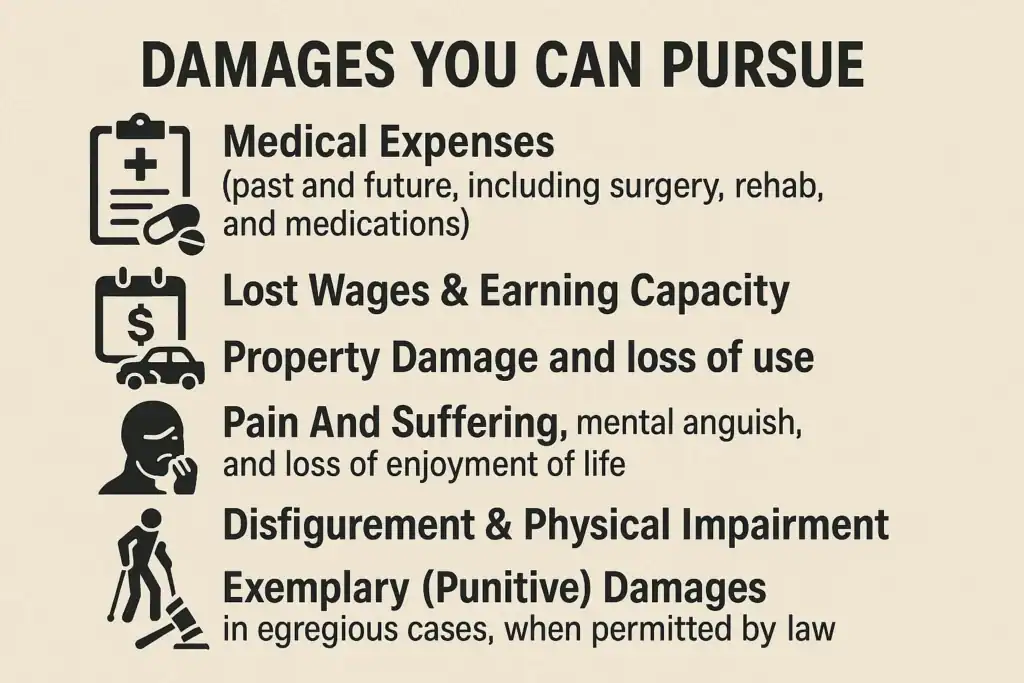
Potential damages in a Texas personal injury claim may include compensation for:
- Past medical expenses
- Future medical care when supported by the evidence
- Lost wages
- Loss of earning capacity
- Physical pain
- Mental anguish
- Physical impairment
- Disfigurement
- Property damage and loss of use
- Wrongful death-related damages when a qualifying family member dies as a result of the collision
- Exemplary damages in cases meeting the applicable legal requirements
There is no reliable one-size-fits-all formula for determining what a truck accident case is worth. Injury severity matters, but so do liability evidence, medical documentation, future treatment needs, lost earning capacity, insurance coverage, credibility, and other case-specific factors.
Francis Injury publishes examples of prior recoveries on its case results page. Past results do not guarantee a similar outcome because every case depends on its own facts, evidence, damages, insurance coverage, and applicable law.
Why Does Medical Documentation Matter?
A truck accident claim involves more than proving that another party caused the crash. An injured claimant must also establish the nature and extent of the injuries and damages being claimed.
Medical documentation can help establish:
- When symptoms first appeared
- The diagnoses made by medical providers
- Imaging and objective findings
- Treatment received
- Restrictions and physical limitations
- Whether surgery or rehabilitation is necessary
- Whether future care is expected
- Whether the injury affects the person’s ability to work
Unexplained gaps in treatment can also become an issue because an insurance company may argue that the injuries improved, were not serious, or resulted from something unrelated to the accident.
See How Medical Documentation Increases Settlement Value for a more detailed discussion.
Should You Give the Trucking Company’s Insurance Adjuster a Recorded Statement?
You should understand who an insurance adjuster represents before providing detailed statements about the collision, your health, or your damages. An adjuster working for the trucking company or its insurer is evaluating the claim for the insurer—not acting as your personal representative.
Be particularly cautious about:
- Recorded statements about how the accident occurred
- Speculating about your speed or distances
- Saying you are “fine” before the full extent of an injury is known
- Signing broad medical authorizations
- Signing releases before understanding what claims are being released
- Accepting an early settlement before future treatment needs are understood
Learn more about common insurance tactics in How Insurance Adjusters Try to Reduce Your Accident Settlement.
How Does a Texas Truck Accident Claim Progress?
No two cases follow exactly the same path, but a commercial truck accident claim often moves through several stages.
- Investigation: identifying drivers, businesses, witnesses, insurance policies, and physical and electronic evidence.
- Evidence preservation: requesting that relevant documents, electronic data, video, vehicles, and other evidence be maintained.
- Medical treatment and documentation: determining the nature of the injuries and the likely effect on the injured person’s life and work.
- Liability analysis: determining which people or companies may be legally responsible.
- Damages analysis: documenting medical expenses, lost income, future losses, and non-economic damages.
- Insurance negotiations: presenting the claim and responding to liability and damages defenses.
- Litigation when necessary: filing suit, conducting written discovery, taking depositions, retaining experts, filing motions, and preparing for trial.
Francis Injury’s Experience With Serious Truck Accident Cases
Truck accident claims benefit from lawyers who understand both commercial trucking evidence and personal injury litigation. Michael Francis, founding partner of Francis Injury, has more than 30 years of personal injury litigation experience and is Board Certified in Personal Injury Trial Law by the Texas Board of Legal Specialization.
Earlier in his career, Michael represented major trucking companies, automobile manufacturers, and insurance providers. That experience gives him insight into how trucking companies and insurers investigate, defend, and evaluate serious accident claims.
Francis Injury’s published case results include commercial truck matters such as a $1.2 million truck-collision settlement involving an unsafe lane change and a $1.05 million recovery involving a commercial tanker truck. Past results do not guarantee a similar outcome, and every case depends on its own facts and circumstances.
Frequently Asked Questions About Texas Truck Accidents
What should I do in the first 24 hours after a truck accident?
How long do I have to file a truck accident lawsuit in Texas?
What evidence is important after a commercial truck accident?
How long does a trucking company keep ELD records?
Can I recover compensation if I was partly responsible for the crash?
Can the trucking company be liable even if the driver caused the accident?
What if black-box data or other trucking evidence disappears?
Should I accept the trucking company’s first settlement offer?
What if there were no eyewitnesses to the truck accident?
How much is a Texas truck accident case worth?
Talk With a Texas Truck Accident Lawyer
A serious commercial truck collision can generate evidence from the driver, motor carrier, vehicle, electronic systems, maintenance providers, witnesses, and other businesses. Determining what happened often requires identifying and preserving those sources before important information disappears.
If you or a family member was injured in a truck accident, Francis Injury can evaluate the collision, identify potential defendants and insurance coverage, investigate available evidence, and explain your legal options.
Call 817-329-9001 or contact Francis Injury online for a free case evaluation.
Francis Injury represents truck accident victims throughout Texas, including clients seeking a Fort Worth truck accident lawyer or Dallas truck accident lawyer.
Injured in a Texas Truck Accident?
Speak with Francis Injury about the evidence, insurance coverage, and legal options that may apply to your case.
Disclaimer: This article is provided for general informational purposes only and does not constitute legal advice. Past results do not guarantee future outcomes. Every case is different, and legal rights and deadlines depend on the specific facts and circumstances involved.