 Skip to content
After a crash on I‑35E, LBJ Freeway, the Dallas North Tollway, or any busy North Texas road, it’s common to walk away thinking you’re “lucky” and only a little sore. Then, hours or days later, lower back pain sets in — making it hard to sit, sleep, or get through a workday.
That kind of lower back pain after a car accident should never be ignored. It can be a sign of serious injury to the muscles, discs, joints, or nerves in your spine. Research suggests that after a motor vehicle collision, a significant share of injured people still have low back pain one year later, with some studies estimating persistent symptoms in at least 31% of cases.
If your crash happened in Dallas, Fort Worth, Arlington, Irving, or anywhere in Texas, you may also have important legal rights. A
Dallas car accident lawyer
can help you connect your lower back pain to the wreck, deal with the insurance company, and pursue the compensation you need for medical care, lost income, and pain and suffering.
Lower Back Pain After a Crash: Why You Should Never Ignore It
Your lower back (lumbar spine) carries most of your body weight and stabilizes your entire upper body. It’s made up of vertebrae (bones), discs (cushions between the bones), facet joints, ligaments, muscles, and nerves that travel down into the legs. Damage to any of these structures can cause intense lower back pain.
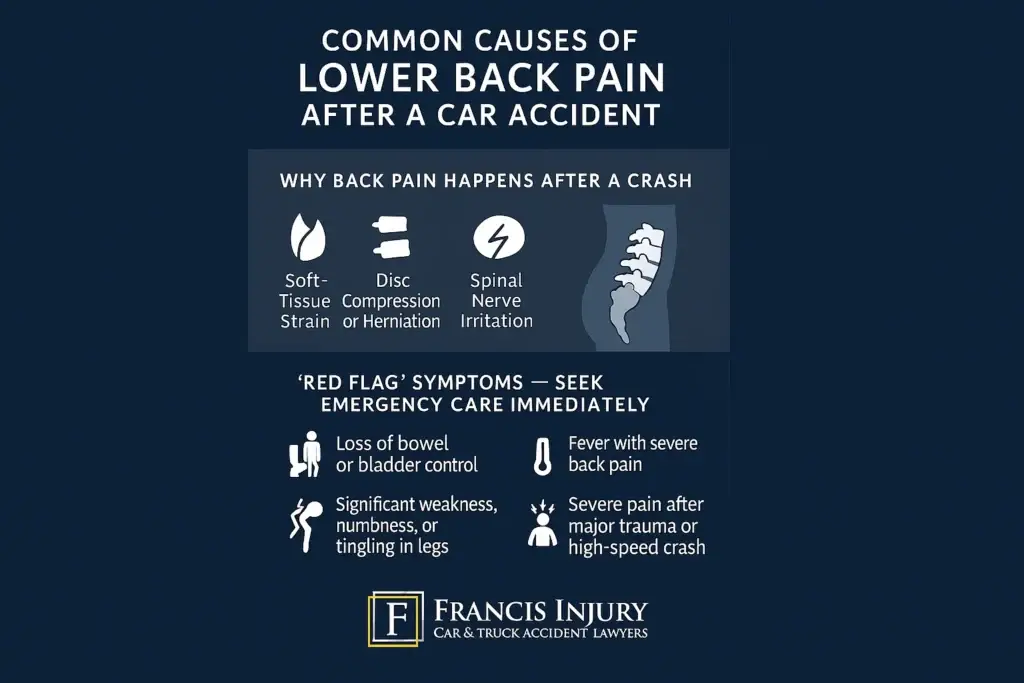
After a collision, even at what feels like a “low speed,” your body absorbs a sudden change in momentum. That force can strain soft tissues, compress discs, bruise bones, or irritate spinal nerves. Medical organizations like the Mayo Clinic note that back pain is often related to muscle or ligament injuries, herniated discs, arthritis, or fractures — all of which can occur or be worsened in a crash.
Get emergency medical care right away if you have “red flag” symptoms such as:
- Loss of bowel or bladder control
- Significant weakness, numbness, or tingling in your legs
- Fever with severe back pain
- Severe pain after major trauma or a high‑speed crash
Even if your symptoms seem mild at first, it’s still important to be evaluated by a healthcare professional and to tell them about the car accident. Early diagnosis protects both your health and your potential injury claim.
How Common Are Car Accident Lower Back Injuries?
Back pain is one of the most common reasons people seek medical care worldwide. When you zoom in on car accidents, the numbers are even more striking:
- A systematic review of motor vehicle collisions found that persistent low back pain one year after a crash occurs in at least about 31% of people who injure their lower back in the collision.
- National traffic data show that millions of people are injured in crashes in the U.S. every year — 2.44 million in 2023 alone.
- In Texas, state crash statistics show tens of thousands of serious injuries from motor vehicle accidents each year, underscoring how often Texans suffer long‑term pain after a wreck.
The bottom line: if you’re feeling lower back pain after a car accident in Dallas or anywhere in Texas, you’re not alone — and it’s not something you should just “tough out.” The pain could be directly related to trauma from the crash, and getting proper care early can improve both your medical recovery and your legal case.
How Car Accidents Damage the Lower Back
Different types of crashes can injure the lower back in different ways. Common scenarios include:
- Rear‑end collisions. A sudden jolt from behind can whip your torso forward and backward. That motion stresses the lumbar spine, pulling muscles and ligaments and compressing discs, even if the bumper damage looks minor.
- Side‑impact (T‑bone) crashes. When your vehicle is struck from the side, your spine can twist or bend sideways abruptly. That can injure facet joints, discs, or spinal nerves, especially in the lower back.
- Head‑on or high‑speed collisions. The force of impact can travel up the seat and seat belt into your spine, potentially causing disc injuries, fractures, or serious ligament damage.
- Rollovers. In a rollover, the body may be thrown around inside the vehicle or compressed by the roof or seat. This can cause catastrophic spinal injuries, including fractures and spinal cord damage.
- Low‑speed crashes and “fender benders.” Even seemingly minor impacts can still injure soft tissues or aggravate pre‑existing degenerative disc disease or arthritis, leading to new or worsened lower back pain.
The severity of your vehicle damage doesn’t always match the severity of your injuries. That’s one reason insurance companies often argue about lower back claims — and why careful documentation is so important.

Common Car Accident Injuries That Cause Lower Back Pain
Lower back pain after a crash is a symptom, not a diagnosis. Several different injuries can be responsible, and more than one may be present at the same time.
Muscle and Ligament Sprains & Strains
Sudden forces can stretch or tear the muscles and ligaments that support the spine. These injuries often cause stiffness, soreness, spasms, and pain that worsens with movement or certain positions. Although many strains heal with time and conservative care, they can be very painful and may limit your ability to work or care for your family.
Herniated or Bulging Discs
The spinal discs act like shock absorbers between vertebrae. In a crash, the soft inner material can push outward through the disc’s outer layer (a herniation), or the disc can bulge. When this material presses on nearby nerves, you may feel:
- Sharp lower back pain
- Pain radiating into the hip, buttock, or leg
- Numbness, tingling, or weakness in one leg
Medical sources note that herniated discs are a well‑recognized cause of low back pain and sciatica. :contentReference[oaicite:6]{index=6} These injuries are common after rear‑end and side‑impact collisions.
Facet Joint Injuries
Facet joints are small joints at the back of the spine that help control movement. Trauma from a crash can irritate, bruise, or misalign these joints, leading to localized lower back pain that worsens when you lean backward, twist, or stand for long periods.
Spinal Fractures and Compression Injuries
High‑energy impacts can cause fractures in the vertebrae. In the lumbar spine, this might show up as compression fractures, where the front of a vertebral body collapses. Symptoms can include intense pain, bruising, and difficulty standing or walking. These injuries are serious and require immediate medical attention.
Pinched Nerves, Radiculopathy, and Sciatica
When a nerve root leaving the spine is compressed or irritated — by a herniated disc, bone spur, or swelling — it can cause radiculopathy. In the lower back, this often appears as sciatica: shooting pain that travels from the low back into the buttock and down the leg, sometimes with numbness or weakness. :contentReference[oaicite:7]{index=7}
Spinal Stenosis Made Worse by a Crash
Some people already have age‑related narrowing of the spinal canal (spinal stenosis) or degenerative disc disease. A collision can aggravate these conditions, turning previously mild or manageable symptoms into significant lower back and leg pain.
Other Injuries That Can “Refer” Pain to the Lower Back
Not all lower back pain originates in the lumbar spine. Hip fractures, pelvic injuries, or severe leg injuries can change how you walk and move, causing secondary strain and pain in your lower back. That’s why it’s so important for doctors to evaluate you from head to toe after a wreck.
Delayed Lower Back Pain After a Car Wreck
Many people leave the scene of a crash feeling “okay,” only to wake up the next morning barely able to get out of bed. This delayed pain is very common:
- Adrenaline and shock can temporarily mask pain.
- Soft tissue injuries and inflammation often peak 24–72 hours after trauma.
- Small disc injuries can worsen over time as swelling or disc material begins pressing on nearby nerves.
The National Institute of Neurological Disorders and Stroke notes that a portion of people with acute low back pain go on to develop chronic symptoms lasting more than a year. :contentReference[oaicite:8]{index=8} That’s exactly why you should take new or worsening pain seriously, even if it didn’t show up immediately after the crash.
For step‑by‑step guidance on what to do in the first hours after a crash, you can also review our detailed guide,
Dallas Car Accident Lawyer Tips: What to Do in the First 24 Hours After a Crash.
How Doctors Diagnose the Cause of Lower Back Pain
Evaluating lower back pain after a car accident typically involves several steps:
- Detailed history. Your doctor will ask when the pain started, where it hurts, what makes it better or worse, whether it travels into your legs, and what happened in the crash.
- Physical examination. They may check your posture, range of motion, reflexes, strength, sensation, and perform specific tests (like a straight‑leg raise) to look for nerve irritation.
- Imaging studies. Depending on your symptoms, your doctor may order X‑rays, CT scans, or MRI scans to look for fractures, herniated discs, or other structural problems. Guidelines generally recommend imaging when there are red flags or persistent symptoms, not for every minor strain. :contentReference[oaicite:9]{index=9}
- Nerve tests. In some cases, nerve conduction studies or electromyography (EMG) are used to evaluate how well your nerves and muscles are working.
You can learn more about common approaches to diagnosing back pain from medical resources like the
Mayo Clinic’s back pain diagnosis and treatment overview. :contentReference[oaicite:10]{index=10}
From a legal standpoint, it’s essential to:
- Tell every medical provider that your pain started after a specific car crash.
- Follow through with recommended tests and follow‑ups.
- Keep copies of all imaging results and reports for your attorney.
Treatment Options for Lower Back Pain After a Car Accident
Your treatment plan will depend on the precise diagnosis, your age and health, and how severe your symptoms are. Common options include: :contentReference[oaicite:11]{index=11}

- Activity modification, not prolonged bed rest. Gentle movement is often encouraged; staying completely still for long periods can actually make many back problems worse.
- Medications. Over‑the‑counter pain relievers, prescription anti‑inflammatory drugs, muscle relaxants, or nerve pain medications may be used under a doctor’s supervision.
- Physical therapy. Targeted exercises, stretching, manual therapy, and posture training can strengthen supporting muscles and reduce pain.
- Chiropractic or osteopathic care. Some patients benefit from spinal manipulation or other hands‑on techniques, when appropriate.
- Injections and interventional procedures. Epidural steroid injections, facet joint injections, or nerve blocks may be recommended for certain disc or joint problems.
- Surgery. In cases of severe nerve compression, spinal instability, or fractures, surgery may be needed to stabilize the spine or decompress nerves.
Always follow your doctor’s advice and ask questions if you’re unsure about a treatment. And remember: getting appropriate care promptly can also strengthen your personal injury claim by showing that you took your symptoms seriously and did everything you could to recover.
How a Lower Back Injury Affects Your Texas Car Accident Claim
Lower back injuries can be complex from both a medical and legal standpoint. Insurance companies often argue that your pain is “just age‑related” or that you were already having problems before the crash. In reality, many people have mild, symptom‑free degeneration in their spine that becomes painful only after trauma.
A strong Texas car accident claim for lower back pain typically depends on:
- Clear medical documentation linking your symptoms to the crash.
- Consistent treatment and follow‑up appointments (gaps in care can hurt your case).
- Objective findings where available (imaging, nerve studies, specialist reports).
- Proof of impact on your ability to work, care for your family, and enjoy life.
Our firm has written extensively about how back and neck injuries are valued in car accident cases. For a deeper dive into how severity, medical bills, and long‑term limitations influence settlement ranges, see our blog
Average Settlement for Car Accident Neck and Back Injuries.
If you suffered a significant lumbar injury, you may also want to review
How Much Is My Back Injury Worth in a Lawsuit?.
These resources can help you understand the factors that go into valuing your case, but they’re no substitute for a personalized evaluation by an experienced Texas trial lawyer.
What to Do If You Have Lower Back Pain After a Car Accident in Dallas–Fort Worth
If you’re dealing with lower back pain after a crash anywhere in the Dallas–Fort Worth metroplex, here are practical steps you can take right now:
- Get medical care as soon as possible. Go to the ER, an urgent care clinic, or your primary doctor, depending on your symptoms. Tell them exactly when the crash happened and when your pain began.
- Follow your treatment plan. Attend all follow‑up appointments, physical therapy visits, and specialist consultations. If a medication or exercise makes things worse, talk to your doctor before stopping on your own.
- Document everything. Keep a folder with medical bills, imaging reports, prescriptions, and notes from doctors. Start a pain journal describing your symptoms, sleep problems, missed workdays, and activities you can no longer do.
- Be cautious with the insurance company. Don’t give a recorded statement or sign anything without legal advice. Insurance adjusters are trained to minimize your claim, especially for back injuries.
- Learn more about your rights. Our post
What Should I Do After a Car Accident?
walks you through key steps to protect your claim. - Talk to an experienced Dallas injury lawyer. A lawyer can coordinate evidence, work with your doctors, and push back when the insurer blames your pain on age or “old injuries.”
Talk to a Dallas Car Accident Lawyer About Your Lower Back Pain
At Francis Injury, our practice is built around helping injured Texans — especially car and truck crash victims in Dallas, Fort Worth, and across the state — rebuild their lives after serious injuries. Our team, led by board‑certified trial lawyer Michael “Mensa Mike” Francis, understands how disruptive lower back pain can be and how aggressively insurance companies often fight these claims.
When you contact us, we can:
- Review your medical records and imaging to understand your diagnosis.
- Explain how Texas law applies to your case and what deadlines you’re facing.
- Gather evidence from the crash scene, witnesses, and experts to prove fault and causation.
- Calculate the full value of your damages — including future medical needs and lost earning capacity.
- Negotiate with the insurance company and, if necessary, take your case to trial.
To learn more about our car accident representation, visit our Dallas Car Accident Lawyer page or our statewide Texas Car Accident Lawyer page. If your injuries go beyond your back and you’re dealing with multiple serious injuries, our Dallas Personal Injury Lawyer
page explains how we handle complex cases.
You don’t have to guess whether your lower back pain is “serious enough” to call a lawyer. If a crash in Dallas, Fort Worth, or anywhere in Texas left you in pain, reach out for a free consultation. There are no upfront legal fees — we only get paid if we recover money for you.
