
Why big-rig crashes are different
- Federal trucking rules, corporate defendants, and high insurance limits make these cases more complex than car crashes.
- Driver fatigue & Hours-of-Service (HOS) violations, ELD/HOS issues, and dispatch pressure.
- Unsafe driving: speeding, tailgating, blind-spot lane changes, and wide turns.
- Cargo problems: overloading, unsecured freight, shifting loads.
- Maintenance defects: bad brakes/tires; failure to inspect or repair.
- Company negligence: unsafe hiring/training/supervision; unrealistic schedules.
- Multiple at-fault parties: driver, motor carrier, tractor owner, trailer owner, shipper, broker, maintenance contractor, and sometimes manufacturers.
What to do after a truck wreck in Fort Worth
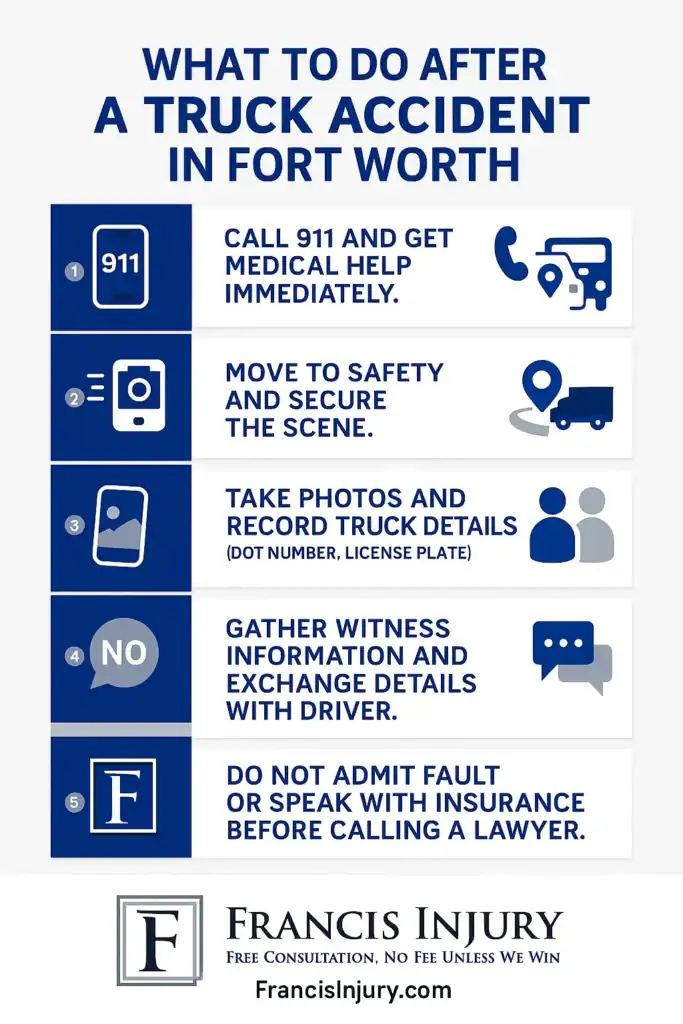
Do this immediately (if safe):
- Call 911 and get medical care (even if injuries seem minor).
- Photograph the scene, vehicles (tractor/trailer), skid marks, road conditions, and visible injuries; capture the truck’s DOT numbers.
- Collect the driver/motor-carrier info and witness names & phone numbers.
- Save dashcam footage, phone photos, repair invoices, and medical records.
- Call us quickly so we can send a preservation (“spoliation”) letter for the truck’s ECM/EDR (“black box”), ELD logs, driver qualification file, dispatch records, maintenance logs, bills of lading, and camera footage.
Avoid these mistakes:
- Do not apologize or guess about fault.
- Do not give a recorded statement to any insurer before speaking with an attorney.
- Do not sign blanket medical releases or accept quick offers without counsel.
How we build your 18-wheeler claim
- Scene & vehicle forensics: inspections, ECM/EDR downloads, brake & tire measurements, trailer/tractor condition.
- Driver/company records: ELD/HOS, trip sheets, dispatch notes, driver qualification file, prior violations, safety/training policies.
- Cargo/route evidence: bills of lading, weight tickets, loading procedures, GPS/telematics, weigh-station data.
- Digital proof: cell-phone records (distraction), cab/dash cameras, traffic cams.
- Expert workups: accident reconstruction, human factors, biomechanics, life-care planning, vocational loss, and economics.
Who may be liable after a semi truck crash?
- Truck driver (speeding, fatigue, distraction, impairment).
- Motor carrier/employer (unsafe hiring/training/scheduling; poor maintenance; regulatory violations).
- Owner/lessor of the tractor or trailer.
- Shipper/loader (improper securement, overweight loads).
- Maintenance/repair contractors (negligent inspection/repair).
- Manufacturers (defective parts, tires, or brakes).
- Government entities (dangerous road design/maintenance; special notice deadlines may apply).
Common causes & crash types we handle
Causes: fatigue, speeding, tailgating, lane departure, distraction/phone use, unsafe turns, brake/maintenance failures, cargo issues, weather. Crash types: jackknife, underride/override, T-bone (intersection), rear-end, rollover, tire blowouts, wide-turn squeeze, tanker crashes. Explore: Common Causes of Truck Accidents · 7 Causes of Truck Accidents in DFW · Jackknife Accidents · Underride Accidents · Truck T-Bone Accidents · Tanker Truck Accidents · Types of Truck Accident ClaimsInjuries we see in big-rig crashes
Catastrophic injuries are common with 18-wheeler collisions: traumatic brain injury (TBI), spinal cord damage, herniated discs, fractures/crush injuries, burns, amputation, and wrongful death. Helpful resources: Injuries in Truck Accidents · Fort Worth Brain Injury Lawyer · Fort Worth Wrongful Death LawyerWhat compensation can I recover?
- Medical costs (ER, surgery, rehab, meds) and future care plans.
- Lost wages & loss of earning capacity.
- Pain, suffering, mental anguish, and physical impairment.
- Property damage & loss of use.
- Wrongful death damages (funeral, loss of consortium/household services).
- Punitive damages when gross negligence is proven.
Deadlines & fault in Texas
- Statute of limitations: Most injury and wrongful-death claims must be filed within 2 years of the crash (some exceptions apply).
- Modified comparative negligence (the “51% bar”): You can recover if you are 50% or less at fault; your recovery is reduced by your percentage. At 51%+, recovery is barred.
- Government vehicles/roads: Special notice deadlines may apply—contact us ASAP.
Bilingual services (Hablamos Español)
Nuestra firma ayuda a víctimas de choques con camiones, tráileres y 18-wheelers en Fort Worth y todo Tarrant County. Hablamos Español. Podemos explicar el proceso legal, coordinar atención médica y mantenerle informado durante todo el caso. Llámenos al 817-329-9001 o contáctenos por nuestra página de contacto.Why choose Francis Injury?
- Local Fort Worth team familiar with I-35W, I-30, I-20, I-820, US-287, and SH-183 corridors.
- Rapid evidence preservation (black box/ELD, dispatch, maintenance records).
- Trial-ready strategy with reconstruction and damages experts.
- Bilingual client service and help coordinating care.
- Contingency fee: No attorney’s fee unless we win.
Free Consultation — Speak With a Fort Worth Truck Accident Lawyer Today
Call 817-329-9001 or request your free case review. No fee unless we win.
Start Free ReviewOffice: 640 Taylor St Suite 1200B, Fort Worth, TX 76102
Useful references: FMCSA Regulations · TxDOT Crash Data
FAQs: Fort Worth Truck Accident Claims
1. What should I do immediately after a truck accident in Fort Worth?
Call 911 and seek medical attention, even for minor injuries. Document the scene, including the truck’s DOT numbers, license plates, skid marks, and road conditions. Gather witness names and contact information. Contact a Fort Worth truck accident lawyer immediately to preserve crucial evidence like black-box/EDR data, ELD logs, dispatch records, and maintenance files.
2. How long do I have to file a truck accident claim in Texas?
Most personal injury and wrongful death claims must be filed within 2 years of the crash. Special rules may apply for accidents involving government vehicles or roads. Acting quickly is essential because evidence and electronic records can be lost.
3. What if I’m partially at fault for the accident?
Texas follows modified comparative negligence (the “51% rule”). You can recover damages if you are 50% or less at fault, though your award is reduced by your percentage of fault. If you are 51% or more at fault, you cannot recover.
4. Who can be held liable in a semi-truck accident?
Liable parties may include:
-
The truck driver (speeding, fatigue, distraction, impairment)
-
Motor carrier or trucking company (unsafe hiring, training, or scheduling)
-
Tractor or trailer owners
-
Shippers/loaders (improperly secured or overweight cargo)
-
Maintenance contractors or mechanics
-
Manufacturers of defective parts or trucks
-
Government entities (dangerous road design or maintenance)
5. What types of evidence are important in a truck accident case?
Critical evidence includes:
-
Black-box/EDR and ELD logs
-
Driver qualification files and dispatch records
-
Maintenance and inspection records
-
Bills of lading and cargo manifests
-
Dashcam, traffic, and surveillance footage
-
Photos of vehicles, skid marks, and road conditions
-
Witness statements and medical records
6. What types of injuries are common in truck accidents?
Truck crashes often result in catastrophic injuries, such as:
-
Traumatic brain injury (TBI)
-
Spinal cord injuries
-
Fractures, crush injuries, and amputations
-
Burns and internal organ damage
-
Wrongful death
7. What compensation can I recover after a truck accident?
Potential recoverable damages include:
-
Medical costs: ER visits, surgeries, rehab, medications, future care
-
Lost income & earning capacity
-
Pain and suffering
-
Property damage
-
Wrongful death damages: funeral, loss of consortium, household services
-
Punitive damages if gross negligence is proven
8. How much is my truck accident case worth?
Case value depends on:
-
Severity of injuries and long-term impact
-
Liability proof and number of at-fault parties
-
Insurance limits and coverage
-
Medical expenses, lost income, and future costs
-
Impact on quality of life and emotional distress
9. Why should I hire a Fort Worth truck accident lawyer?
Truck accident cases are complex due to federal trucking regulations, multiple liable parties, and high insurance limits. An experienced lawyer will:
-
Preserve critical evidence quickly
-
Investigate the accident thoroughly
-
Identify all liable parties
-
Negotiate with insurance companies
-
Represent you in court if necessary
10. Does Francis Injury offer bilingual services?
Yes. Hablamos Español. Our team can guide Spanish-speaking clients through the legal process, coordinate medical care, and provide updates throughout the case.
Resources for Truck Accident Victims
Hospitals & Level I Trauma Centers
- Texas Health Harris Methodist Hospital Fort Worth – Level I trauma center with advanced stroke, cardiac, and brain-tumor care. Emergency care 24/7.
- John Peter Smith (JPS) Hospital – Public Level I trauma & teaching hospital offering psychiatric and interpreter services.
- Baylor Scott & White All Saints Medical Center – Not-for-profit full-service hospital with cardiology, transplant, women’s & children’s services.
- Medical City Fort Worth Hospital – Tertiary referral center offering 24-hour ER, neurology, orthopedics, and transplant services.
Pediatric Care
- Cook Children’s Medical Center – Leading pediatric hospital with a Level II pediatric trauma center and helipad for critical cases.
Community Health Access
- Las Vegas Trail Health Center – New community clinic combining Cook Children’s pediatric services with JPS adult care under one roof. A trusted, multilingual resource for local families.
Crash Reporting & Documentation
- Crash Report Access – Obtain Fort Worth accident reports from local law enforcement or the Texas Department of Transportation’s Crash Records Information System for essential evidence.